
Programming Reality: AI is moving from content to coordination
AI is no longer confined to generating content or supporting analysis. It is beginning to coordinate physical operations in real time, shifting advantage toward those who can govern decisions across infrastructure, flow, and execution.
Signal
AI is moving into live operating environments.
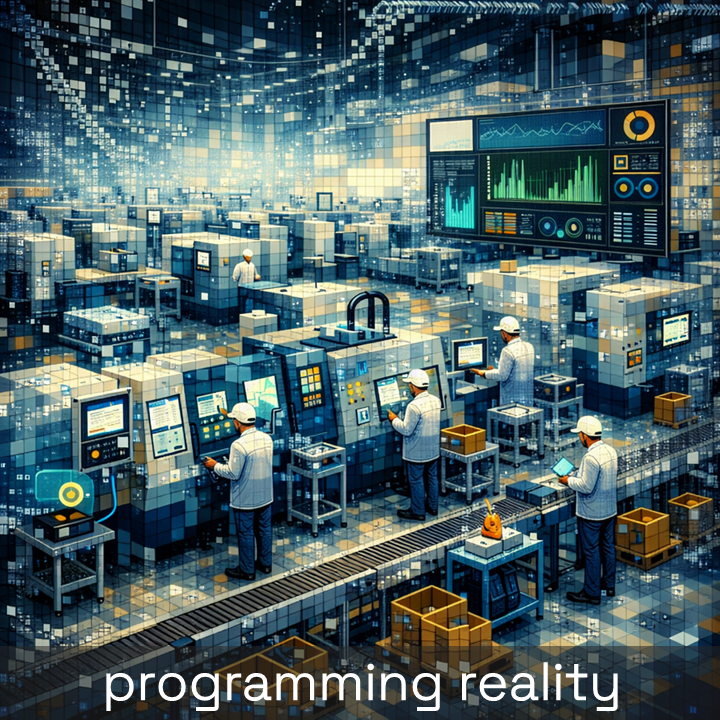
Across manufacturing, logistics, robotics, and industrial systems, physical operations can now be sensed, timed, routed, and adjusted in real time. Warehouses reassign flow dynamically. Production systems optimize around changing constraints. Supply systems adapt as capacity, timing, and demand move.
The important shift is not simply that these environments are digital. It is that they can now be coordinated by software in ways that directly affect execution, timing, and flow.
Why it matters
The earlier phase was digitization. The next phase is real-time coordination of assets, workflows, and movement.
Once physical systems can be monitored and adjusted continuously, the strategic question changes. The issue is no longer where software sits in the business. The issue is where control sits in the system. As sensing, inference, and infrastructure converge, factories, warehouses, transport networks, and service environments begin to operate less as fixed assets and more as systems that can be adjusted continuously.
That changes where value accumulates. It does not move first to the most visible interface or the most polished model. It moves toward the layer that governs timing, flow, utilization, and action across the system. In practical terms, the advantage shifts toward coordination.
Operational consequence
This is not just an AI story. It is an infrastructure, workflow, and decision story.
When environments become adjustable in real time, organizations need more than analytics. They need clear ownership over the decisions that matter, trusted signal flows, and rules for when action should be triggered automatically, escalated, or stopped. Without that, more intelligence simply produces more recommendations, more latency, and more exposure.
For operators, this means the real design problem is no longer just automation. It is decision architecture. Which loops need to run in real time? Who owns them? Which signals are trusted enough to trigger action? Which thresholds make those actions safe and reviewable? These become operating questions, not technical afterthoughts.
For SMEs, the consequence is immediate. As systems become more coordinated, smaller firms are increasingly dependent on larger operating systems, logistics networks, and platforms they do not control. The strategic question becomes whether to plug in, differentiate, hybridize, or remain outside and accept declining leverage over time.
Decision implication
Leaders should stop asking where AI can be added and start asking where physical operations are becoming programmable in their operating environment.
A useful first step is to identify one workflow where timing, routing, capacity, or execution now changes faster than human coordination can comfortably manage. That is where the next decision bottleneck is likely to appear.
A workflow becomes a valid candidate for orchestration when delay between signal and action is repeated, commercially visible, and reducible through trusted signals, clear thresholds, and reversible responses.
If the workflow matters commercially, it needs a named owner, a trusted signal set, clear proof conditions, and a bounded action path. The question is no longer whether AI will influence operations. It already is. The more important question is who will control the decision loop as physical systems become programmable.
