About Loop Exit
Loop Exit is a strategic decision-and-design practice for intelligent operational systems.
We help organizations define where intelligence belongs before capital hardens around the wrong architecture.
The work sits upstream of deployment. It starts where AI pressure, workflow friction, ownership ambiguity, or premature infrastructure debate make the next move harder to judge. The goal is to turn that ambiguity into one bounded, reviewable path.

One owner. One proof threshold. One bounded path
Upstream by design
Loop Exit is not a hardware reseller or a software vendor.
The practice works upstream of deployment and can remain involved after the initial sprint as a decision-loop advisor, pilot-definition partner, architecture translator, or scale-layer oversight partner.
Where deeper technical build paths are required, we help define the technical handshake and partner path without collapsing independence.
If the issue is real, the owner exists, and the stakes are material, that is enough to start.
Why this practice
Many organizations are now dealing with the same pattern: too many plausible initiatives, too little decision quality, and infrastructure choices being discussed before the operating logic is clear.
That leads to pilot drift, weak ownership, fragmented workflows, and commitments that are difficult to reverse.
Loop Exit exists to improve decision quality before scale.
How we work
Our work is design-led, commercially grounded, and governance-aware.
We work across strategy, research, narrative, interaction, spatial systems, and AI. That breadth is deliberate. It helps us connect signals across disciplines, clarify what matters, and translate complexity into a path that can be owned, tested, and defended.
In practice, that can mean defining a decision bottleneck, shaping a bounded pilot, translating between business and technical stakeholders, or helping a team decide what should move forward, what should be reworked, and what should stop.
What this looks like in practice.
A useful way to understand Loop Exit is through one project built as a three-act sequence: attention, trust, dialogue.
In earlier work with 3M, I helped shape a series of global customer innovation centers designed to do more than present technology. They aligned teams around clearer shared stories and created environments where customers could open up about real problems.
That logic still informs Loop Exit today. The medium may change — space, workflow, pilot, or decision system — but the pattern remains the same: create attention, build trust, and open the conditions for dialogue that leads to action.
The attention-trust-dialogue narrative — examples shown here — still shapes how I think about change: as something people must be able to feel, interpret, and carry forward.

Make the value visible.
Surface what matters in a way that is immediate, elegant, and worth engaging. In the 3M centers, this meant moving perception from supplier to partner by making technologies tangible, immersive, and memorable.
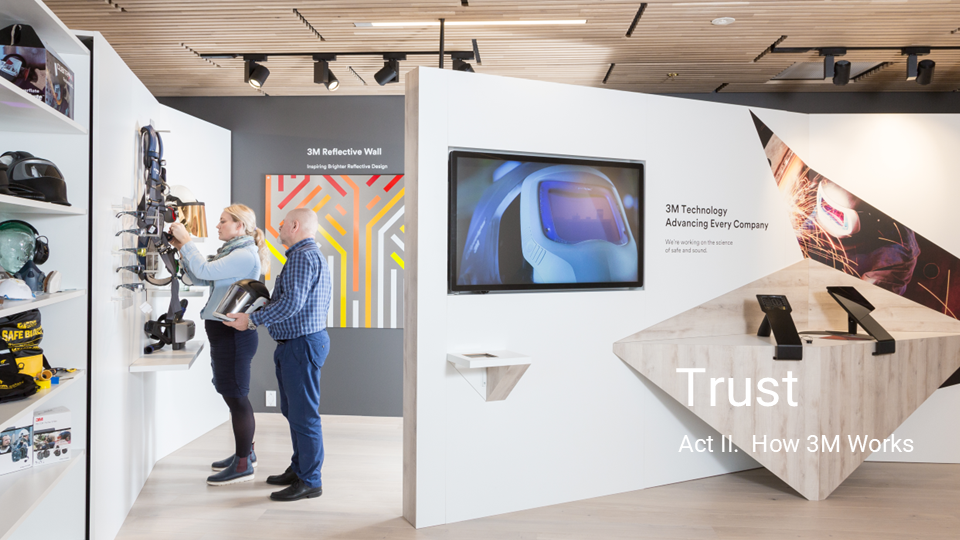
Make the system believable.
Translate complexity into an experience people can understand, navigate, and relate to. The environment helped 3M teams tell more consistent stories from within, while giving customers enough clarity and confidence to open up about their own challenges.

Create the conditions for co-creation.
The goal was not display alone, but better conversation. Once attention and trust were established, the space became a setting for shared problem-framing, solution-building, and new commercial opportunities rooted in real-world needs.
Practice Director

Christopher Schutte is a strategist and systems designer working at the intersection of operational intelligence, spatial systems, interaction logic, and organizational change under constraint.
His work combines strategic framing, systems thinking, decision design, spatial intelligence, and experience logic to help clients move from possibility overload to one coherent path forward.
The role of the practice is to improve decision quality under uncertainty and turn that improvement into a funded next move.
Origin of the practice

I founded Loop Exit to connect forms of work that are too often kept apart: narrative, design, research, front-end innovation, platforms, spatial systems, XRAI, and AI.
Over time, I saw the same problem across sectors and teams. Disciplines were working in parallel without enough shared logic. Strategy was being discussed separately from execution. New systems were being introduced without enough attention to the people expected to trust them, use them, and carry them forward.
That experience shaped the practice. But the deeper thread came from elsewhere too: immersive spaces, persuasive design, and the conviction that change does not hold when it is only described. It holds when people can feel it, interpret it, and integrate it into how they act.
Loop Exit was built to reduce fragmentation, improve decision quality under uncertainty, and help organizations define a path that is coherent, governed, and usable in practice. The emphasis on decision integrity, bounded proof, and embodied change comes directly from that work.
Built with people, not done to them
Strategy does not hold in slide decks. It holds when people can interpret, trust, and act on the system around them.
That is why narrative, interface clarity, adoption, and decision legitimacy matter here. They are not secondary to change. They are part of how change becomes real inside an organization.
I started Loop Exit with a simple conviction: change only holds when it becomes usable in practice. It has to be legible enough to be understood, governed enough to be trusted, and tangible enough to be felt.
Designing futures people can feel is one way to describe that longer trajectory. The work may begin with decisions, pilots, or infrastructure. But the deeper aim is to help people inhabit change in a way that is real enough to carry forward.
Clients & teams
Projects have taken me across industries, from cultural institutions to emerging technology, working in and alongside design studios, startups, global agencies, and larger organizations.
Loop Exit™ is my current platform for this work, shaped by years of collaboration through independent practice, embedded roles, and partnerships across wider ecosystems.
No one does it alone. These experiences inform how I work today: connecting strategy, systems, narrative, and decision design to help organizations move from possibility overload to a more coherent next move.
One owner. One trusted signal set. One bounded path.
The goal is one next move that can be funded, tested, or stopped with confidence.