
The Boring Layer Wins: value moves below the interface
Most attention still goes to models, assistants, and visible interfaces. But in physical systems, value is accumulating in the layers that increase throughput, control capacity, and improve utilization across production, storage, and movement.
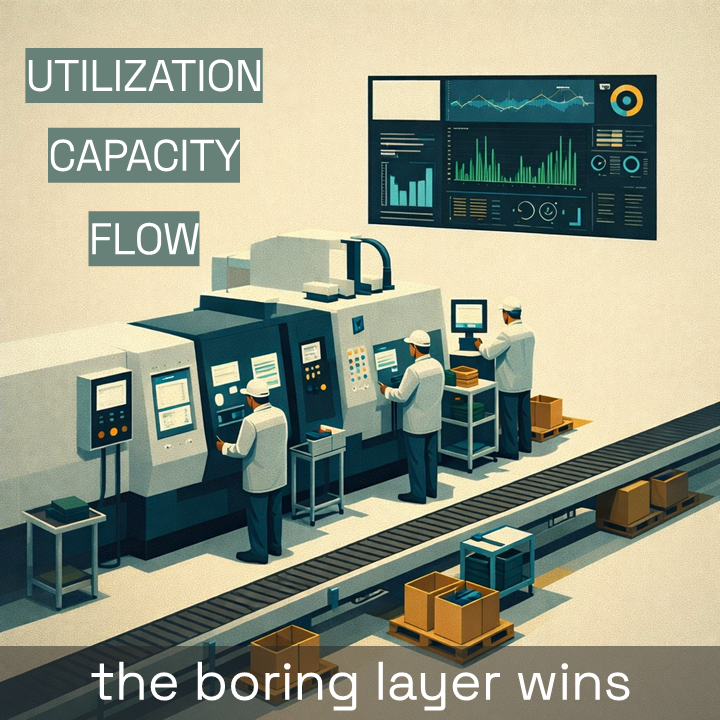
Fund the layer that improves throughput, capacity, utilization, or coordination — not the layer that is simply most visible.
The Boring Layer Wins
Signal
Capital and attention are still concentrated on visible AI layers.
Most AI discussion focuses on models, copilots, interfaces, and humanoid narratives. But in physical operating environments, those are rarely the first places where durable advantage is created. The more consequential shift is happening in the underlying system: the ability to coordinate production, storage, and movement more precisely, more continuously, and with less idle time.
That is why the underlying operating layer is becoming more valuable. Not because it is glamorous, but because it is where throughput is determined.
Why it matters
When systems become continuously coordinated, value begins to move toward the layers that shape capacity, flow, and utilization.
That changes the competitive picture. Warehouses are no longer passive storage. Logistics is no longer a background service. Industrial production is no longer judged only by output, but by how continuously and responsively it can operate inside a wider system. Specialized robotics matter not because they are futuristic, but because they solve narrow, constrained, high-value problems with immediate operating consequences.
The result is a structural shift in where leverage sits. Firms that control throughput often gain more durable advantage than firms with the most visible interface or the most visible commercial position.
Operational consequence
Leaders should pay closer attention to the layers beneath the product story.
In practical terms, this means asking where value in the system is actually being captured. Is it in the asset that transforms material, the node that holds capacity, the network that routes movement, or the logic that coordinates them together? Those questions matter more than surface-level claims about AI adoption.
For operators, this changes investment logic. The issue is not simply whether to experiment with new tools. It is whether those tools improve throughput, reduce exposure, increase usable capacity, or improve coordination in a measurable way. If they do not, they remain interface enhancements rather than operating advantages.
For SMEs, the message is sharper. You are not competing with frontier model labs. You are competing on your position relative to the system layers that actually control flow.
Decision implication
Before funding new AI initiatives, identify which layer in your system determines value creation most directly.
The operating owner of the workflow, investment path, or transformation program should make this call before new AI spending is approved.
If that layer is production, focus on transformation speed and uptime. If it is storage, focus on capacity, location, and responsiveness. If it is logistics, focus on routing, coordination, and timing. If the real leverage sits in the connection between those layers, the priority becomes orchestration.
An initiative only qualifies if it improves throughput, capacity, utilization, or coordination in a measurable way. If it does not, it should not be treated as an operating priority.
The visible interface still matters. But when physical operations become more continuously coordinated, value tends to settle below it. Organizations that understand this early will make better decisions about where to invest, where to integrate, and where to avoid distraction.
Read the next pattern in the Programming Reality series.
