
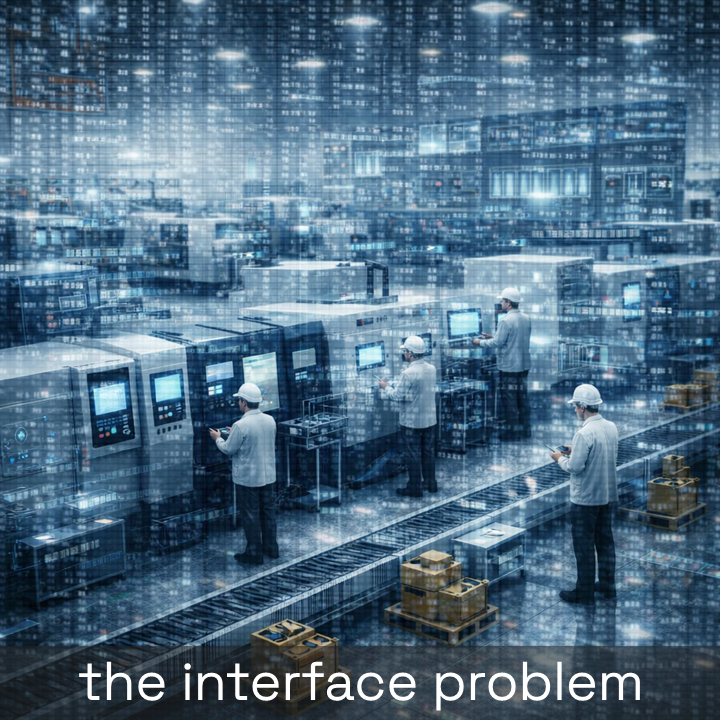
The Interface Problem: when systems move faster than decision-making
As operating environments become more real-time, interconnected, and continuously adjustable, the main constraint is no longer compute alone. It is the growing lag between what the system is doing and what humans can still perceive, interpret, and act on in time.
Fund the layer that improves throughput, capacity, utilization, or coordination — not the layer that is simply most visible.
Signal
Many organizations still describe their challenge as a tooling problem. In practice, it is becoming an interface problem.
Systems across logistics, manufacturing, infrastructure, and operations are now more sensing-rich, more interconnected, and more dynamic than the human decision environment built around them. The system adjusts continuously. The operator often reacts episodically. This mismatch is widening as environments become more instrumented and more interdependent.
That is the real bottleneck. The issue is not that the system lacks data. It is that the human interface to the system was not designed for the speed, volume, and decision complexity now required.
Why it matters
This changes the meaning of visibility.
For years, organizations have treated dashboards, reports, and alerts as proxies for control. But greater visibility does not guarantee better action if the human decision layer remains too slow, too fragmented, or too overloaded to respond within the time window that matters. A dynamic system paired with a static interface creates a hidden operating risk: teams appear informed even when action still lags.
That lag has commercial consequences. Capacity is underused. Exceptions accumulate. Signals arrive too late to change the outcome. By the time a problem is visible at the management layer, the underlying system may already have moved on. What looks like a coordination issue on the surface is often a perception and decision-latency issue underneath.
Operational consequence
Leaders need to distinguish between monitoring a system and operating inside it.
In practical terms, that means identifying where human review still sits in the middle of loops that now move too quickly for manual interpretation. Which decisions still rely on inboxes, reports, or fragmented tools? Where are teams being asked to synthesize too many signals before acting? Where does the system generate recommendations faster than the organization can convert them into governed action?
This is especially important in environments where speed, utilization, and coordination drive value. When the decision layer cannot keep pace, organizations compensate with meetings, oversight, and escalation. That can preserve caution, but it also introduces delay and gradually degrades control. The system continues to move even when the interface cannot keep pace.
Decision implication
Before adding more AI, review where the current interface is already failing.
A good starting point is to map one workflow where the timing of the decision matters commercially and ask four questions. What signals matter most? Who actually interprets them? How much lag exists between signal and action? And what part of that lag is caused by interface design rather than capability limits?
The operating owner of the workflow should lead this review before additional tooling, reporting, or AI layers are added.
The review is useful only if it identifies measurable lag, locates where human interpretation is slowing action, and changes how the workflow is governed.
The emerging constraint is not only compute, infrastructure, or model quality. It is whether the people responsible for the system can still perceive what matters clearly enough to act in time. When they cannot, the problem is no longer one of visibility. It is one of control.
Read the next pattern in the Programming Reality series.
