
Culture Follows the Loop
Why experimentation becomes valuable only when real bottlenecks are named, one owner is accountable, and evidence is strong enough to change behavior.
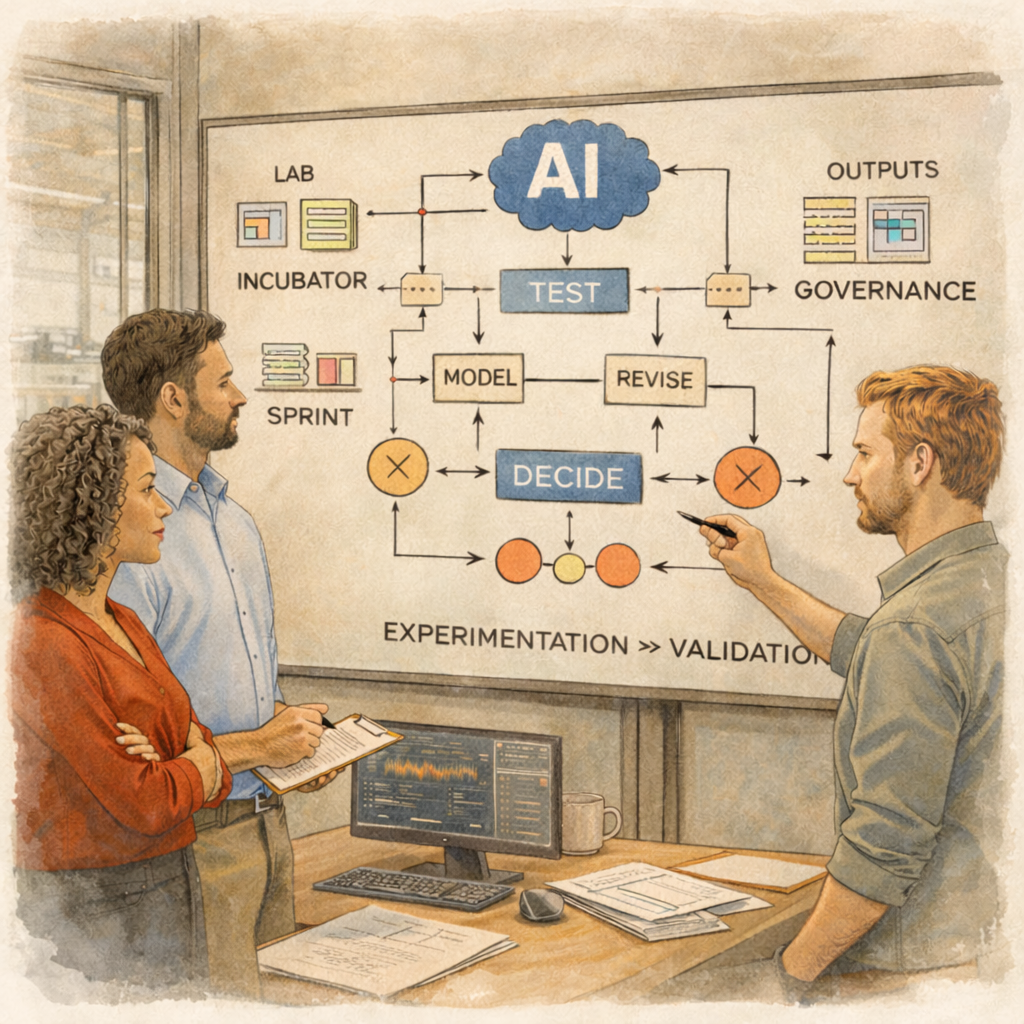
A culture of experimentation is not installed through language. It emerges when one bounded loop is tied to a real bottleneck, one accountable owner, and one measurable outcome.
Signal
A familiar pattern is appearing across organizations under AI pressure. The ability to generate options, run tests, and produce output is increasing quickly, but the ability to choose what deserves attention is not improving at the same pace.
That mismatch creates a specific kind of drift. Teams accumulate ideas, pilots, tools, and possible initiatives, yet the agenda remains too broad, ownership stays diffuse, and the experiments are only loosely connected to real operating pressure: customer friction, downtime, approval delays, workflow breakdowns, or energy waste already visible in the business. What looks like innovative energy often turns out to be fragmented activity with no disciplined path to learning or scale.
This matters more now because execution itself is becoming less scarce. AI and computation make it easier to generate, simulate, test, and iterate. But lower execution cost does not remove the need for judgment. It raises the premium on deciding which experiment matters, which bottleneck is real, and which problem is important enough to deserve one of the organization’s limited slots for attention.
Why it matters
Most organizations do not fail because they lack willingness to experiment. They fail because experimentation is not attached to a disciplined operating logic.
Culture of experimentation is not a slogan. In practice, it means recurring tests tied to real metrics, real bottlenecks, and real owners. It emerges when people can see that the organization chooses fewer priorities, names the real bottleneck, assigns one accountable owner, and ties time, money, and attention to measurable outcomes. Without that discipline, experimentation becomes ambient activity rather than decision infrastructure.
There is also an outside-in issue that gets missed when experimentation is framed too internally. A strong culture of experimentation addresses real pressure from the field: customer complaints, frontline delays, workflow friction, downtime variance, approval lag, or avoidable energy use. That is where durable value tends to come from. Not from cleverness in the abstract, but from solving problems that are difficult, structural, and close to how the world actually works.
Products are optional. Workflows are not.
That is why execution is no longer the main story. The harder question is which experiments deserve to exist at all. Before organizations redesign around future work models, they need a more immediate discipline: choosing fewer things, choosing them for real reasons, and running them in a way that produces evidence instead of noise.
Operational consequence
Leaders should treat experimentation as a governed portfolio of bounded tests, not as a broad cultural aspiration.
The first move is to narrow the agenda. Choose a small number of priorities that people can actually name. Define each one as an outcome, not an initiative. Find the main bottleneck limiting progress. Assign one accountable owner. Then force every experiment to justify itself against that outcome and that constraint. If the experiment does not help move a real metric, reduce real friction, or test a real decision, it is not yet worth organizational attention.
The second move is to go outside-in. Talk to customers, operators, frontline teams, and the people living inside the workflow. The goal is not to collect more opinions. It is to identify where the friction is real enough to matter and where the organization can become structurally useful rather than merely interesting. The strongest experiments are usually anchored in the part of reality that software alone does not simplify away: operational complexity, domain constraints, human workflows, and institutional pressure.
The third move is to make the review cadence real. Weekly for bottlenecks and required decisions. Monthly for trend and resource use. Quarterly for keep, kill, scale, or redesign. This is how bounded tests stop being activity and become accountable learning.
A useful proof threshold is simple: fewer escalations, shorter cycle time, reduced downtime, lower review burden, measurable energy savings, or a clearer decision path under live conditions. If those changes are not visible, the experiment may be interesting, but it is not yet valuable.
Decision implication
The executive question is no longer, “How do we encourage more experimentation?”
It is: “Which small number of real problems deserve experiments now, what single bottleneck are we trying to move, and who is directly answerable for the result?”
A useful first move is to eliminate broad innovation language and force each proposed experiment through a harder filter: what real outcome should improve, what visible constraint makes this worth testing, who owns it, and what evidence will tell us whether to keep, kill, or scale it. That is how experimentation changes behavior rather than just increasing activity.
Choose fewer priorities, define the real bottleneck, talk to the people closest to the problem, and require every experiment to justify itself against one measurable outcome.
