
The New Human: from future sensing to accountable cognition
The New Human is the foresight and cognition layer behind a newer phase of Loop Exit. It explores future tensions, white mirror scenarios, and adaptive pressures so leadership teams can test whether judgment remains traceable, owned, and defensible when AI changes how signals are interpreted and decisions are made.

Use future tension scenarios to test how judgment behaves under AI pressure, and keep only what produces traceable, owned, and defensible decisions.
Signal
AI is entering leadership, governance, and operational decision-making faster than most organizations can explain how judgment is actually forming.
That creates a deeper problem than tool adoption. Once AI mediates perception, options, and recommendations, the issue is no longer only what the system produces. It is how humans interpret signals, apply priors, make tradeoffs, and retain authorship under pressure. The New Human frames cognition as a combination of structured reasoning, learned pattern recognition, and probabilistic inference under uncertainty. Current AI systems can be impressive, but they are also jagged, data-hungry, and often non-general in ways that matter for real decisions.
The New Human began as a way to prototype future conditions people could step into — immersive, embodied situations where gesture, dialogue, and presence completed the story. That origin matters because it explains why it is now useful as a diagnostic substrate: not to discuss the future in theory, but to observe how judgment behaves inside it.
This is the signal behind The New Human. The question is not whether organizations should think about futures. It is whether they can still think clearly when AI changes the conditions of judgment.
Why it matters
This is where The New Human becomes relevant to the current face of Loop Exit.
The New Human is not a parallel speculative project. It is the research and foresight layer behind a more decision-grade practice. Its tensions and white mirror scenarios are useful because they expose where adaptive capacity breaks: autonomy against automation, speed against sensemaking, agency against system incentives, efficiency against meaning, optimization against resilience. Those are not abstract themes. They are the fault lines along which decisions become harder to own.
This signal can be framed in three ways. First, human decisions are shaped by priors: background beliefs, assumptions, and learned expectations, not just fresh data. Second, what looks irrational is often resource-limited inference under real constraints. Third, intelligence is not one-dimensional, which means AI support does not remove the need for human judgment; it changes where judgment must be exercised more carefully. That makes The New Human useful as a decision environment, not just a futures narrative.
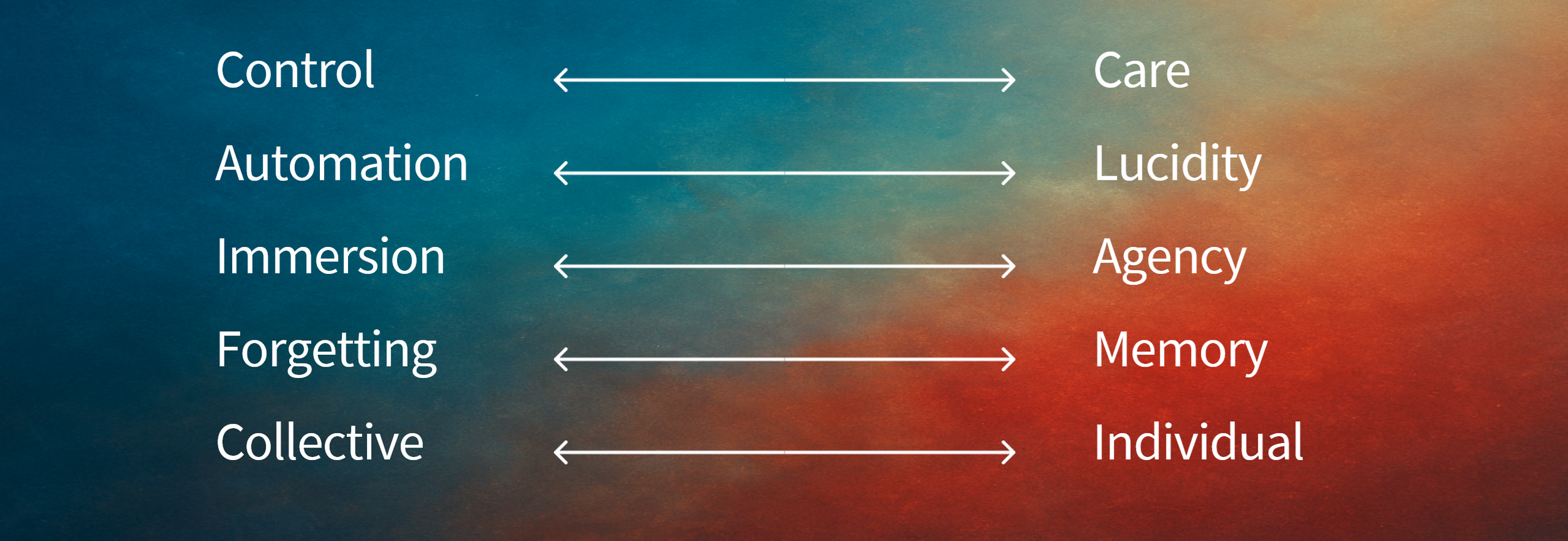
Five tensions. One future under pressure. Use them to shape how people choose, adapt, resist, and belong in the futures ahead.
Operational consequence
Accountable Cognition Lab is where this research becomes operational.
It uses future tension scenarios as bounded tests of judgment under AI pressure. Participants work through one consequential scenario and make choices under conditions where perception, inference, and responsibility are stressed. The aim is not to generate answers. It is to produce evidence: how judgments form, where tradeoffs become explicit or disappear, where ownership weakens, and whether a human can still stand behind the decision. That is why ACL is better understood as a capability probe than as a workshop.
Where public cultural formats explore social imagination broadly, Loop Exit uses The New Human more narrowly: as a structured scenario layer for testing adaptive capacity, decision quality, and leadership judgment under pressure.
The executive sponsor, strategy lead, or transformation owner should use one The New Human scenario as a bounded test before broader leadership, capability, or innovation work is expanded.
The exercise is useful only if it produces visible evidence of how judgment forms, where accountability weakens, and what next move becomes clearer as a result. If it remains interesting but non-diagnostic, it is not doing enough.
Decision implication
Use The New Human scenarios as bounded tests of cognition under pressure, not as open-ended futures exercises.
A useful first move is to select one near-future tension that matters commercially or institutionally, then run it through Accountable Cognition Lab with one defined decision in view. The question is whether the resulting judgment can be reconstructed clearly enough to show:
what signals mattered
which priors shaped interpretation
what tradeoffs were surfaced
who owned the decision
whether the final commitment remained defensible
That is the bridge.
The New Human generates the pressure condition.
Accountable Cognition Lab shows how judgment behaves inside it.
Loop Exit uses that evidence to define a clearer next move.
