
Backcasting: use the future to eliminate weak initiatives now
Most initiative portfolios are too full because they are filtered by enthusiasm, local sponsorship, or near-term logic alone. Backcasting, used inside First Exits, works as a pruning discipline: it tests whether an initiative still holds under credible future conditions before more time, budget, or managerial attention is committed.
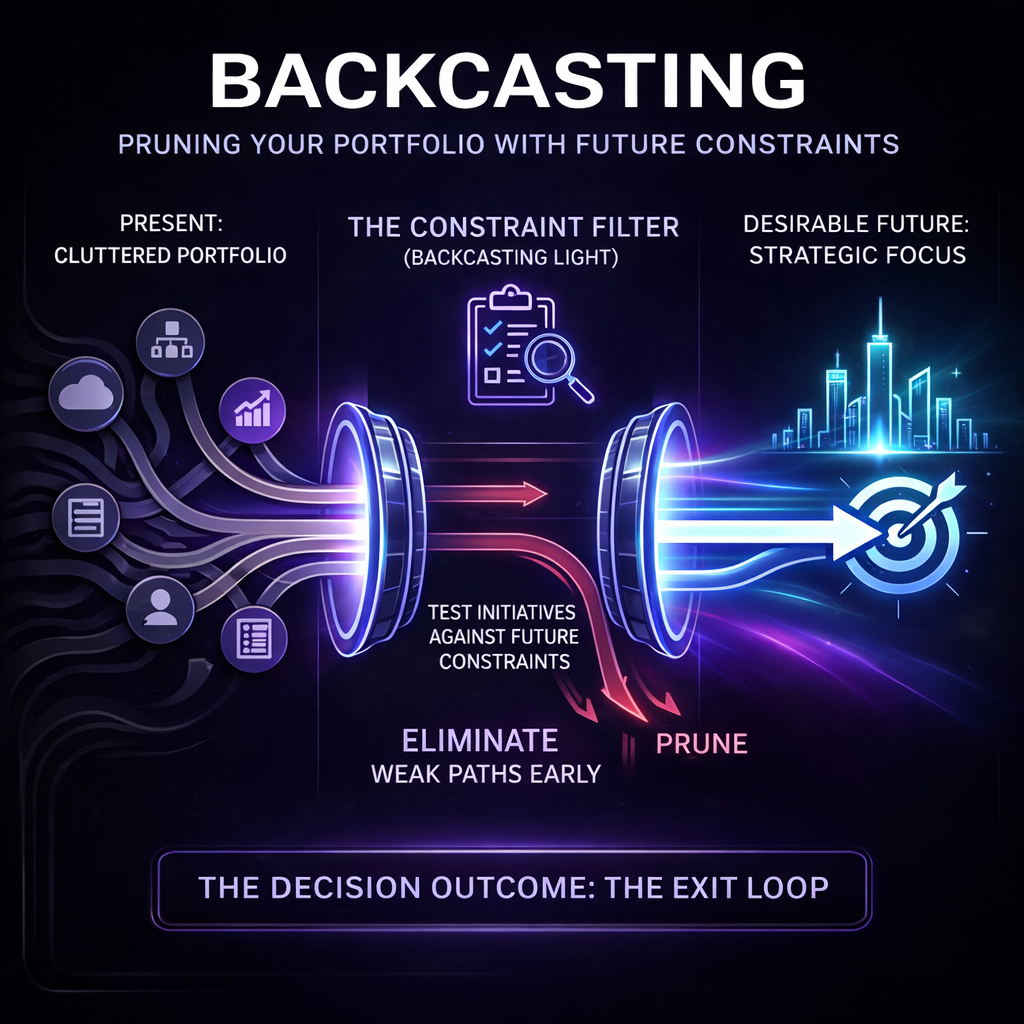
Before additional scoping, budget, or roadmap work is approved, test each major initiative against structural, capacity, and regulatory pressure.
Signal
Many organizations are trying to prioritize too many projects at once.
AI, automation, workflow redesign, and infrastructure pressure create a constant stream of ideas, pilots, and internal proposals. The problem is rarely lack of activity. It is lack of disciplined elimination. Teams continue funding initiatives because they are already in motion, because a sponsor wants them preserved, or because they appear useful under today’s assumptions. What is often missing is a forward constraint test: would this initiative still deserve commitment if the operating environment changed in credible but demanding ways?
That is where backcasting becomes useful. Not as a broad planning exercise, but as a bounded filter.
Why it matters
Most weak initiative portfolios do not fail because they lack imagination. They fail because they tolerate too many weak paths for too long.
An initiative that only works under optimistic assumptions is not necessarily a strategic option. It may be a future exposure. Inside First Exits, the role of backcasting is to force a more defensible question: does this project still make sense if we test it against a plausible 2–5 year structural future, a capacity contraction scenario, and a regulatory tightening scenario? If it collapses under those credible conditions, it should not survive the portfolio. That is not pessimism. It is commitment discipline.
This matters because pruning is often more valuable than adding. Portfolio quality improves when weak options are removed early and managerial attention is concentrated on paths that still hold under forward pressure.
Operational consequence
Backcasting should operate in two modes.
The first is Backcasting Light, embedded inside First Exits. Its purpose is not to produce a full roadmap. Its purpose is to eliminate. Each initiative is tested against credible future constraints and either survives or is removed from consideration. The logic is simple: if the project cannot survive plausible forward conditions, it does not deserve further scoping. This embedded version supports Step 2 without changing the underlying elimination discipline.
The second is Backcasting Deep, used only when exposure is high, the horizon extends beyond three years, or the decision implies systemic transformation. In those cases, the work can go further: defining what must be true, what operating conditions must be built, which milestones matter, and what must stop in order to make the desired future operationally credible. But that is an add-on, not the default mode.
This distinction matters because many teams reach for roadmap work too early. They attempt to plan futures before they have narrowed the field enough to justify planning.
Decision implication
Before expanding an initiative portfolio, run a backcasting filter on each major candidate.
The portfolio owner should run this filter before additional scoping, budget, or roadmap work is approved.
Ask whether the initiative survives three tests:
a plausible 2–5 year structural future
a capacity contraction scenario
a regulatory tightening scenario
If it fails under credible forward constraint, eliminate it. If it survives and the exposure is material, then deeper backcasting may be justified to clarify milestones, dependencies, and stop-doing choices. That sequence keeps the process disciplined.
The value of backcasting is not that it helps teams imagine a better future. Its value is that it helps them stop protecting projects that do not lead there.
