
Operations is becoming the Intelligence Layer
Why AI value now depends on decision integrity inside the workflow, not capability beside it.
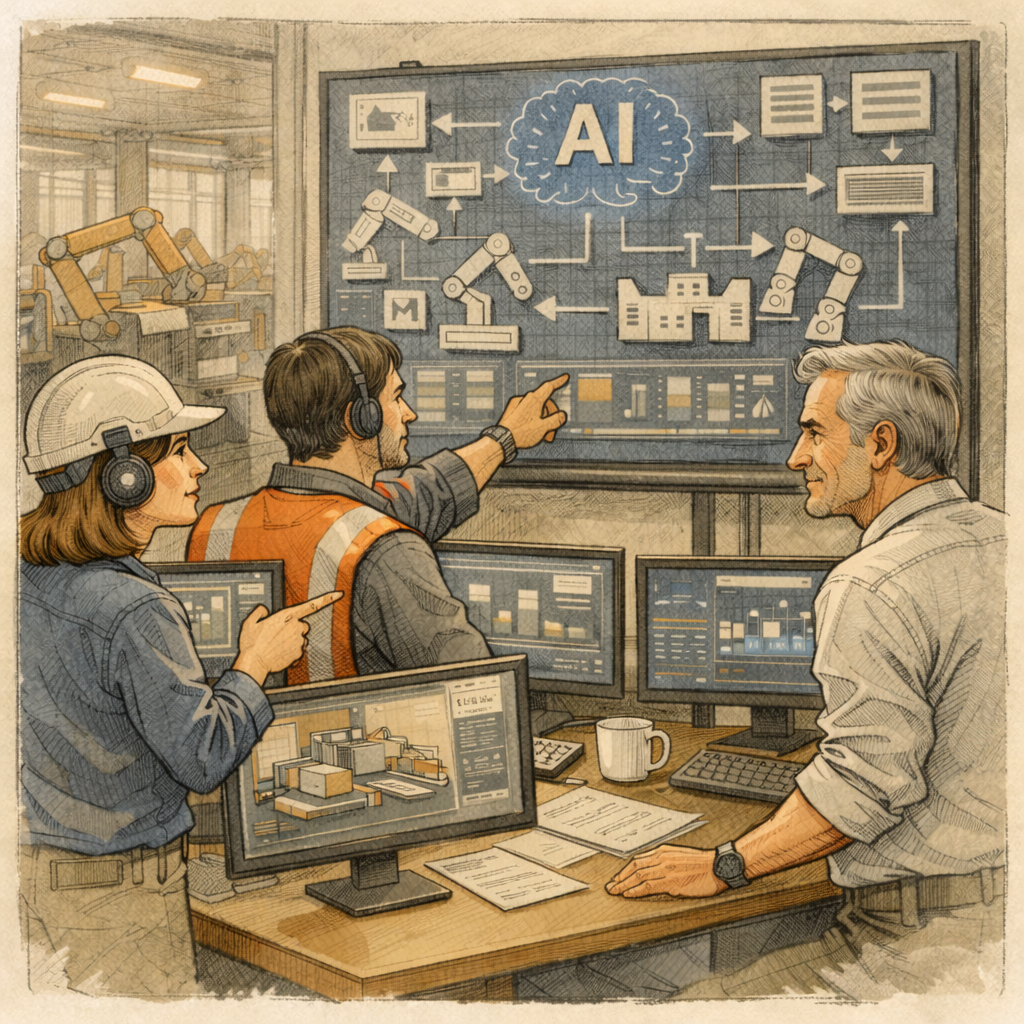
Design the decision path before expanding intelligence. One owner, one trusted signal set, one bounded loop.
Signal
A consistent pattern is emerging across enterprise and industrial environments.
In the last phase of adoption, AI mostly sat beside the workflow. It lived in browser tabs, sidecar copilots, document tasks, and low-risk experiments. Useful, but peripheral. That condition is changing. AI is moving closer to the live state of work: the condition of a process, the exception inside a handoff, the operational choice that must be made in time.
At the same time, most organizations already observe a great deal. They have dashboards, alerts, ERP, MES, reports, telemetry, and analytics. Yet action still stalls. The problem is rarely a total absence of information. It is that the path from signal to decision to action remains unclear, overloaded, or unowned. Visibility increases, but performance does not improve proportionally.
That is the signal worth paying attention to.
The question is no longer whether AI can generate insight. It is whether the organization has built the conditions required to let that insight influence, support, or trigger action in a controlled way.
Proof is simple: the decision runs with fewer approvals, lower latency, and no increase in manual oversight.
Why it matters
This is where many AI programs begin to misfire.
Organizations buy visible capability while the operating loop underneath remains weak: no trusted state, no clear owner, no escalation logic, no action boundary. The result is predictable. The workflow drifts, the system creates activity without leverage, and the tool gets blamed for failures that are actually structural.
The real issue is not model quality alone. It is whether the decision layer is designed well enough to carry intelligence under live conditions. That means a decision must have an owner, a signal set trusted enough to matter, a path for escalation or intervention, and a way to reverse or contain exposure when reality does not cooperate. Without those conditions, intelligence accumulates as reports, alerts, and recommendations rather than becoming operational advantage.
There is a second issue that external stakeholders increasingly recognize once systems become more active: managerial attention becomes a constraint. If AI increases output but also increases approvals, reviews, exception handling, and override work, then the system may appear faster while becoming harder to govern. In that situation, the problem is not a lack of intelligence. It is that the decision burden has been pushed back onto humans in a weaker form. The result is supervision drag rather than leverage. That is why decision integrity matters. It protects the quality of the decisions that remain.
Operational consequence
Leaders should treat operations as the layer where AI must be proved, not as a downstream implementation detail.
The practical task is straightforward, even if execution is not. Choose one loop that matters. Define the decision clearly. Assign one accountable owner. Compress the signal set to what genuinely changes the decision. Establish thresholds for action, escalation, and stop conditions. Build reversibility where the exposure justifies it. The aim is not to add more intelligence to the environment. The aim is to build a governed decision path that can act in time without creating avoidable review burden.
This is the shift from software adoption to operating design.
What becomes less valuable is generic AI capability without workflow fit, more dashboards that stop at observation, and feature-led procurement disconnected from ownership. What becomes more valuable is trusted operational state, named decision ownership, explicit action logic, and workflows that can hold under pressure without constant intervention.
For external stakeholders, this changes the conversation materially. AI is no longer just a productivity story. It is increasingly an architecture, governance, and control story. The organizations that benefit will not necessarily be the ones with the most tools. They will be the ones that identify the right workflows, from maintenance timing to order routing, and turn system activity into governed action with one owner, one proof threshold, and one bounded loop at a time.
Decision implication
Before expanding AI further, choose one operational decision, assign one owner, define trusted signals and thresholds, and prove the loop before scaling it.
A useful first move is to identify where latency, recurring manual judgment, exception handling, or weak handoffs are already visible in the operating model. From there, define the owner, determine which signals are trusted enough to trigger action, specify when the system should act or escalate, and make the proof threshold explicit. If the loop cannot be made legible, owned, and reversible, it should not be scaled.
The advantage is not having more AI in the organization.
It is having one governed decision path that improves timing, control, and operating confidence under real conditions. That is where operations becomes the intelligence layer.
