
Efficient AI is now an operating discipline
Why workflow classification and model routing will matter more than frontier-model access.
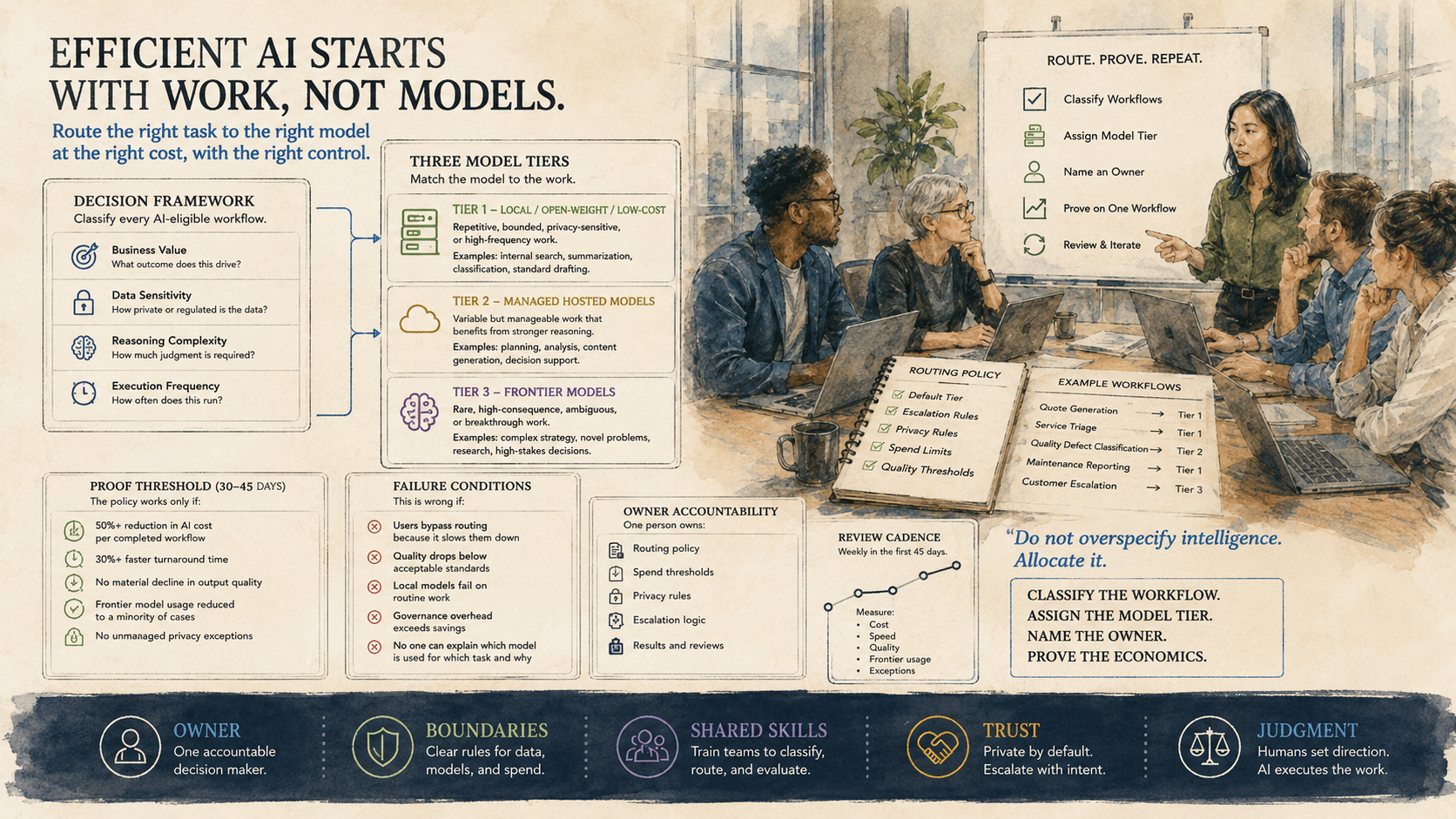
Classify the workflow, assign the model tier, name the owner, and prove the economics.
Signal
A practical split is forming. Frontier models remain valuable for a narrow class of high-ambiguity, high-stakes work. But a much larger share of everyday tasks can now be handled by smaller, local, or open-weight models at a fraction of the cost, with better privacy, lower latency, and greater control.
That changes the executive question. It is no longer, “Which model is best?” It is, “Which work are we overspecifying?” If a routine workflow can be completed to an acceptable standard by a cheaper model, using a frontier model is not sophistication. It is waste.
Why it matters
AI spend is about to behave like any other operating cost. Once it enters recurring workflows, finance will scrutinize it.
The firms that win will not be those with the most pilots or the strongest vendor relationships. They will be the ones that build an intelligence allocation policy before cost, privacy, and workflow sprawl get away from them.
For most organizations, the current failure mode is simple:
premium models are being used for low-value work
confidential information is leaving the business unnecessarily
teams cannot scale adoption because every use case is treated as exceptional
no one owns routing, escalation, or spend discipline
This is the same mistake companies make in operations when they use skilled specialists for routine tasks, premium tooling for ordinary jobs, or expensive line time for work that could have been handled upstream. AI is no different. The waste is real. It is simply less visible because it sits inside tokens, subscriptions, and fragmented experiments rather than on a machine utilization report.
Operational consequence
The implication is straightforward: segment the work before deploying AI into it.
For a CEO or COO, the operating move is simple.
Step 1: Classify the top 10 recurring AI-eligible workflows.
Use four variables only:
business value
sensitivity of data
complexity of reasoning required
frequency of execution
Step 2: Assign each workflow to one of three model tiers.
Tier 1: Local / open-weight / low-cost
For repetitive, bounded, privacy-sensitive, or high-frequency work.
Examples: maintenance note summarization, internal search, first-pass triage, routine classification, standard drafting.
Tier 2: Managed hosted models
For variable but manageable work that benefits from stronger reasoning without requiring frontier cost by default.
Tier 3: Frontier models
For rare, high-consequence, ambiguous, or breakthrough work where superior reasoning materially changes the result.
Step 3: Name one owner.
One person must own the routing policy, spend thresholds, privacy rules, and escalation logic. In most firms this will sit with the CIO, COO, or digital operations lead.
Step 4: Prove it on one workflow first.
Choose one workflow with visible friction:
quote generation
service triage
quality defect classification
maintenance reporting
customer support escalation
Do not start with a platform narrative. Start with a bottleneck.
Begin with local conditions, real interactions, and one contained experiment. Make a strategic choice, accept the trade-off, and define what you are not doing. If it does not change the economics or speed of a real workflow, it is not a business result.
Proof threshold
The policy is working only if it produces measurable operating improvement within one review cycle.
For the first 30–45 days, the threshold should be explicit:
50%+ reduction in AI cost per completed workflow
30%+ faster turnaround time
no material decline in output quality
frontier-model usage reduced to a minority of cases
no unmanaged privacy exceptions
If those conditions are not met, the routing logic is wrong, the workflow was chosen poorly, or the stack is too complex to operate.
Failure conditions
This thesis is wrong in practice if:
users bypass the routing layer because it slows them down
quality drops below acceptable operating standards
local models fail on supposedly routine work
governance overhead exceeds savings
no one can explain which model is used for which task and why
That is the point. This is an operating test.
Decision implication
Do not approve a frontier-first AI rollout without workflow classification, named ownership, and a proof threshold.
The immediate executive decision is this:
Within 30 days, require the AI owner to classify the top 10 AI workflows, assign a default model tier to each, define escalation rules, and prove the policy on one live workflow with cost, speed, and quality metrics reviewed weekly.
That is the decision that turns AI from a technology discussion into an operating discipline.
Do not overspecify intelligence. Allocate it.
Classify the workflow, assign the model tier, name the owner, and prove the economics.
Read next: Proof Before Scale
How Loop Exit runs bounded pilots before broader commitments harden.
