
AI adoption needs rails, not ceilings
Why AI adoption needs governed workflows, protected judgment, bounded exposure, and uncapped team capability
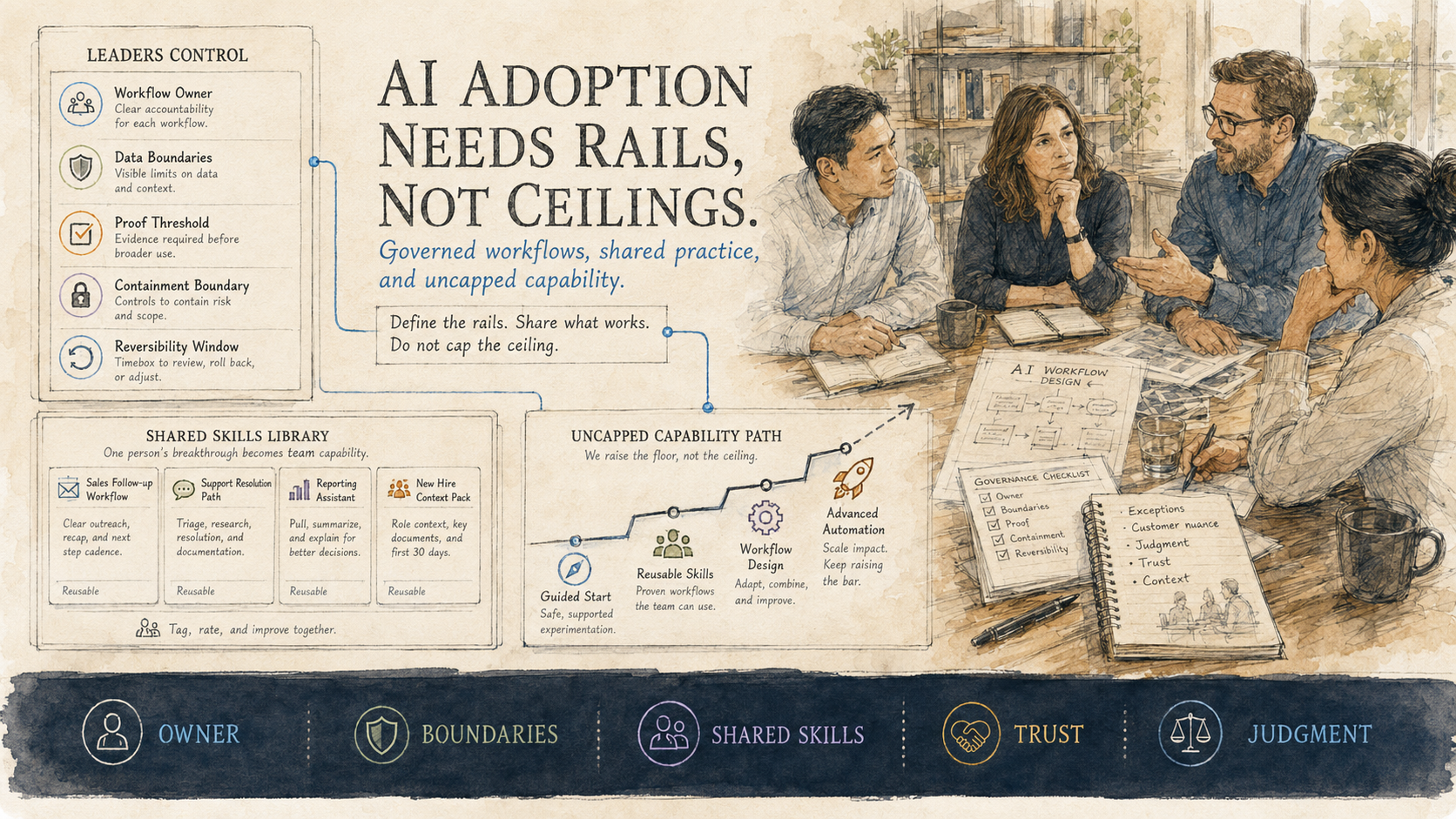
Define the rails, not the ceiling.
Signal
A visible pattern is emerging inside AI adoption programs.
Companies have more tools, more training, more executive pressure, and more employees experimenting with AI. Yet the work often remains fragmented. One team finds a useful workflow. Another starts from scratch. Individual users develop private prompting habits. Managers see more drafts, summaries, and suggested actions, but not always better decisions.
The result is activity without leverage.
This is why the Ramp example matters. Ramp did not discover that employees needed another reminder to use AI. It discovered that broad AI usage was not the same as organizational AI capability. The bottleneck was the operating environment: fragmented setup, disconnected tools, weak context, repeated configuration, and no easy way for one person’s better workflow to become everyone else’s baseline.
That is the signal worth paying attention to.
AI adoption is moving from individual prompting to operating design.
Why it matters
Most companies still frame AI adoption too narrowly.
One version treats adoption as a compliance problem: everyone must use AI, usage must increase, and resistance must be corrected. That produces performance without trust. People use the tools because they are expected to, not because the workflow has become better.
Another version treats adoption as open experimentation: let teams explore and see what happens. That protects initiative, but it can create duplication, cost exposure, inconsistent quality, security risk, and local workflows that never become shared capability.
Both approaches miss the operating problem.
Teams need agency, but agency needs rails. Those rails are not artificial limits on ambition. They are the conditions that make experimentation safe enough to matter: data permissions, security boundaries, workflow ownership, escalation thresholds, audit trails, human judgment points, reversibility windows, and proof conditions.
There is also a quieter risk. A workflow is not only a sequence of tasks. It carries operating memory: exceptions, shortcuts, customer nuance, informal escalation paths, craft judgment, and learned ways of getting things done. AI can make explicit knowledge more searchable and reusable, but it can also accelerate the loss of tacit knowledge if leaders automate the visible process while ignoring the practical knowledge that keeps it working.
That is why leaders should define the rails, not the ceiling.
The rails protect the organization. The absence of a ceiling lets teams discover value that leadership could not fully prescribe in advance.
Operational consequence
Leaders should stop asking, “How do we get everyone to use AI?” and start asking, “Which workflow is ready for governed AI use?”
The practical move is to choose one consequential workflow. Assign one accountable owner. Map the current work, including the explicit process and the tacit knowledge it depends on. Define what AI is allowed to access, what it may generate, what it may automate, what must remain human judgment, and what evidence must remain traceable.
Then let the team work inside those boundaries.
Do not prescribe every use case in advance. Do not reduce the system to a low-ceiling assistant that only performs safe generic tasks. Do not assume nontechnical users should remain permanently limited to simplified AI interactions. The stronger move is to raise the floor while preserving the ceiling: make setup, context, permissions, and reusable workflows easier, while allowing capable users to keep extending what the system can do.
In operator language, the pilot needs a clear value target and a bounded blast radius. It should have one owner, one workflow, defined permissions, explicit stop conditions, and a containment boundary before scale.
This is where the Ramp lesson becomes useful without needing to copy Ramp. A useful sales workflow, support workflow, reporting workflow, or onboarding workflow should become inspectable, reusable, versioned, and governed. It should not remain private craft. One person’s breakthrough should become a team baseline only when the decision exposure is understood.
Scenario planning adds the second discipline. Before scaling, leaders should ask what happens if the workflow succeeds. Who gains speed? Who gains burden? Who loses control? Which exceptions become harder to see? Which stakeholders are expected to trust the system? What path dependencies are created? What must remain reversible if the workflow creates risk at scale?
The pilot is not enough.
The organization has to prove that the operating conditions around the pilot can hold.
Decision implication
Before expanding AI adoption, choose one workflow and design the operating environment around it.
Today, the decision whether to control or empower has passed. The decision is what to control.
Control the exposure. Control the data boundaries. Control the decision points. Control the audit trail. Control the escalation logic. Control the proof threshold. Control the reversibility window.
Do not control the ceiling of capability too early.
If the trial improves timing, quality, reuse, decision confidence, and review burden, it can graduate. If it only increases output, prompts, drafts, or activity, it should stop or be redesigned.
Usage is not proof enough.
A better workflow is proof.
Choose one consequential workflow, name the owner, map the explicit and tacit knowledge it depends on, define the decision exposure and containment boundary, then scale only if the work improves.
Read next: Proof Before Scale
How Loop Exit runs bounded pilots before broader commitments harden.
