
Co-Intelligence inside the agentic web
Why agent-mediated discovery requires both machine-readable offers and human-resonant experience design.
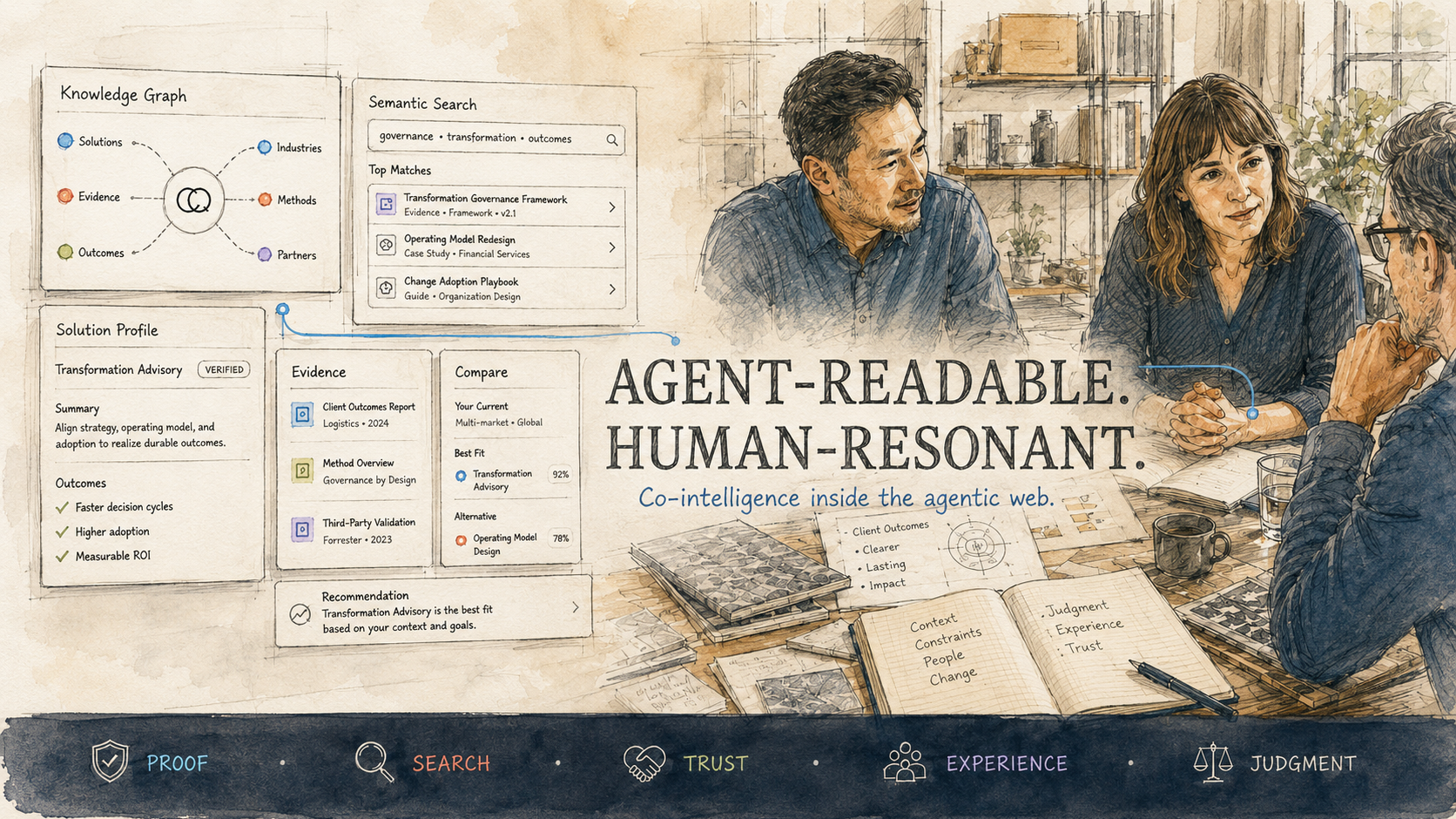
Make the offer legible to agents, but keep the source of trust human.
Signal
A buyer asks an AI system for a shortlist.
Not a search result.
Not a list of links.
A recommendation.
“Find three credible partners for this problem.”
“Compare the strongest options.”
“Summarize the evidence.”
“Tell me who is worth speaking to.”
That is the business condition now forming around AI-assisted search, vendor comparison, procurement summaries, and research workflows.
The first reader may no longer be the buyer.
It may be the agent acting on the buyer’s behalf.
This is why Ethan Mollick’s move from Co-Intelligence to Co-Existence matters. The shift is easy to misread. It does not mean human collaboration with AI is finished. Co-intelligence still matters: judgment, context, taste, responsibility, and meaning-making remain central.
The change is that co-intelligence now sits inside a wider agentic web.
The old pattern was:
human asks → AI assists → human judges
The emerging pattern is:
human intent → AI searches, filters, compares, ranks, recommends → human receives a mediated shortlist
We can already see the direction in generative books, machine-readable research, agent-oriented search, procurement summaries, and product pages prepared for non-human interpretation.
The signal is that commercial discovery is becoming partially agent-mediated before human trust begins.
Why it matters
Most companies are not ready for this.
Their offer depends on a sales call. Their differentiation lives in a founder’s head. Their proof is buried in decks, PDFs, proposals, case studies, or scattered website pages. Their language sounds clear to people who already understand the context, but vague to a system trying to compare options.
That creates a new commercial risk.
An agent may summarize the company too generically.
It may compare the offer on the wrong terms.
It may miss the strongest evidence.
It may recommend the wrong fit.
It may leave the company out entirely.
This is not just an SEO problem.
SEO helped companies become findable. Agent-mediated discovery asks whether a company can be understood, compared, and recommended in context.
But the opposite failure is also real.
If a company optimizes only for machine readability, it becomes flat. Easy to parse, but hard to care about. Clear enough for comparison, but weak in the moment where trust, chemistry, judgment, and commitment still matter.
That is the tension leaders need to hold.
The offer must be machine-readable.
The experience must remain human-resonant.
Operational consequence
This needs an owner.
Not “the website team.”
Not “marketing content.”
Not “AI experimentation.”
One commercial owner should take responsibility for one priority offer and make it legible under agent comparison.
That owner should be accountable for the offer architecture: what the offer is, who it is for, what problem it solves, what evidence supports it, where it fits, where it does not fit, and how it compares to plausible alternatives.
An agent-readable offer has a clear proof threshold.
It should allow an AI agent to:
identify the right buyer or use case
summarize the offer accurately
find supporting evidence
distinguish it from adjacent alternatives
understand constraints and conditions
avoid recommending it where it does not fit
If the agent produces a generic summary, misses the evidence, compares on the wrong terms, or recommends the offer to the wrong buyer, the offer is not yet agent-readable.
That is the product layer.
The experience layer has a different job.
The sales conversation, workshop, assessment, executive dialogue, or client journey must carry what the agent cannot: trust, memory, judgment, and commitment quality.
The agent may create the shortlist.
The human experience still has to earn the relationship.
Decision implication
The executive question is:
“Can an AI agent understand, compare, and recommend one priority offer without flattening what makes us valuable?”
A useful first move is to choose one commercially important offer and assign one commercial owner.
Structure the claims.
Surface the proof.
Clarify the use cases.
Name the constraints.
Define the comparison logic.
Then test it.
Can an agent summarize the offer correctly?
Can it find the evidence?
Can it distinguish the offer from alternatives?
Can it identify where the offer should not be used?
Only after that should the human experience be evaluated.
Does the buyer encounter something specific, credible, and hard to substitute?
Does the conversation create trust after the agent has done the first pass?
Does the relationship deepen rather than collapse into comparison?
That is the operating choice.
Make the offer legible to agents.
Keep the source of trust human.
Choose one priority offer, assign one commercial owner, structure its claims and proof for agent interpretation, and test whether the human experience still creates trust after the first machine-readable pass.
Read next: Proof Before Scale
How Loop Exit runs bounded pilots before broader commitments harden.
