
Programming Reality: the system recap
Physical systems are becoming more sensing-rich, coordinated, and adjustable in real time. The strategic consequence is that control is shifting away from the visible product and toward the system underneath it, especially the layer that defines and executes decisions in time.
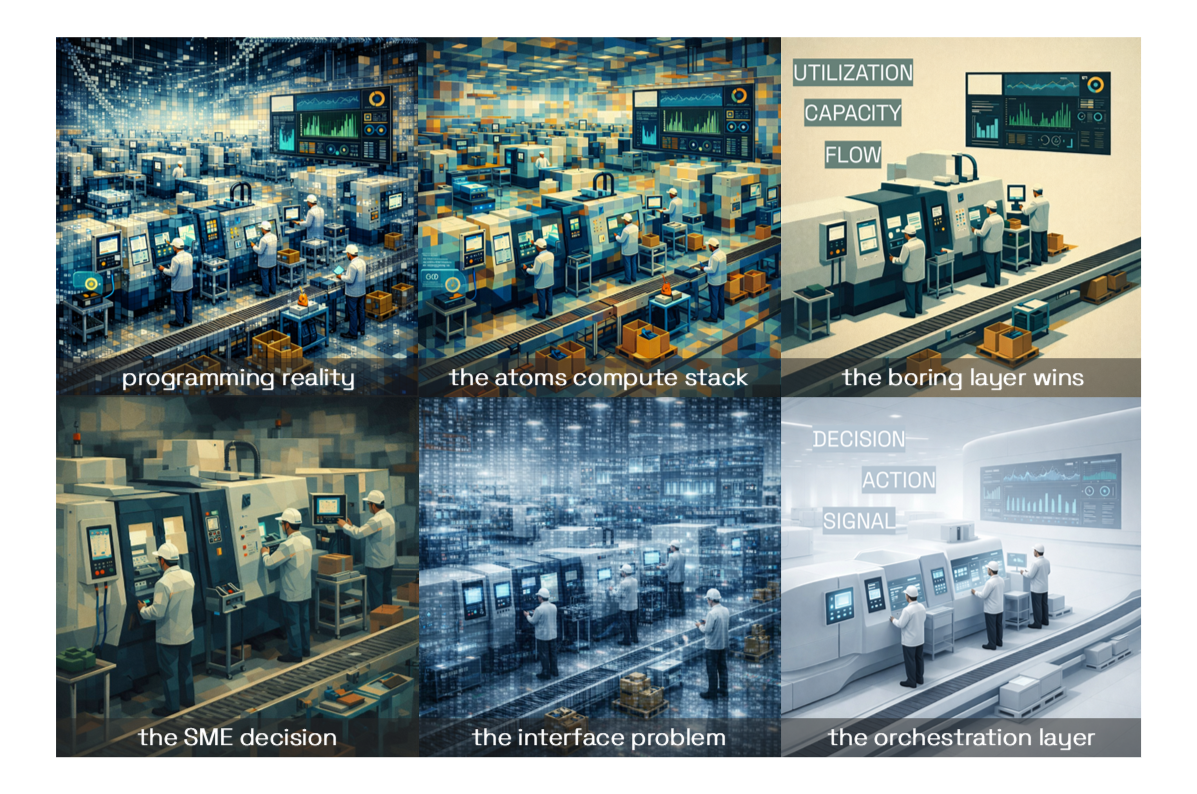
Start with one workflow that matters commercially, then test whether leverage, dependency, lag, and decision ownership are clear enough to justify commitment.
Signal
Across the series, one pattern has become clearer.
Physical environments are becoming more instrumented, more connected, and more responsive to software. What used to be treated as separate domains—production, storage, movement, and control—now behave more like interdependent layers in one coordinated system. This is why the phrase programming reality is useful. It names a shift from static operations to physical systems that can be sensed, adjusted, and coordinated continuously.
Why it matters
This is not just another wave of automation language.
The deeper change is that control no longer sits primarily in the product, the interface, or the claim of using AI. It moves into the system: into how capacity is organized, how movement is routed, how signals are interpreted, and how decisions are triggered across infrastructure. That is why the sequence matters as a whole. Each piece points to the same conclusion from a different angle. Reality becomes more programmable. The physical world begins to organize as a stack. Value moves below the interface. Position becomes strategic. Human decision-making starts to lag system speed. A new orchestration layer becomes necessary.
Operational consequence
For leaders, this changes the level at which strategy must be framed.
It is no longer enough to ask whether a company has adopted AI, modernized systems, or improved visibility. The more useful questions are harder and more specific. Which system do we actually operate inside? Where does leverage sit in that system? Which layer determines our speed, margin, or exposure? Where are decisions still too slow for the environment they are meant to govern? And who, in practice, controls the loop that turns signals into action?
This is why the Programming Reality sequence points beyond commentary. It leads toward a more disciplined operating view: map the stack, locate the leverage, identify the lag, and define the decision layer that matters. Without that, more intelligence can increase activity without improving control.
Decision implication
A useful next move is to review the series not as seven separate ideas, but as one operating model.
Start with one workflow that matters commercially. Determine where it sits in the stack, what constrains its throughput, where dependence is emerging, what lag exists between signal and action, and whether the decision path is owned, governed, and reversible.
The operating owner of the workflow or transformation path should lead this review before broader roadmap, partnership, or infrastructure commitments are made.
The review is only useful if it clarifies leverage, dependency, lag, and decision ownership well enough to support a funded, refined, or stopped next move.
As industries become more coordinated in real time, the central strategic question is no longer only what you build. It is where you sit, what you control, and whether your decision layer can act in time.
