
The Orchestration Layer: control moves to the decision path
As infrastructure becomes more dynamic and AI becomes more capable, the decisive advantage does not come from more visibility alone. It comes from the layer that defines decisions clearly, compresses signals to what matters, and triggers action in time.
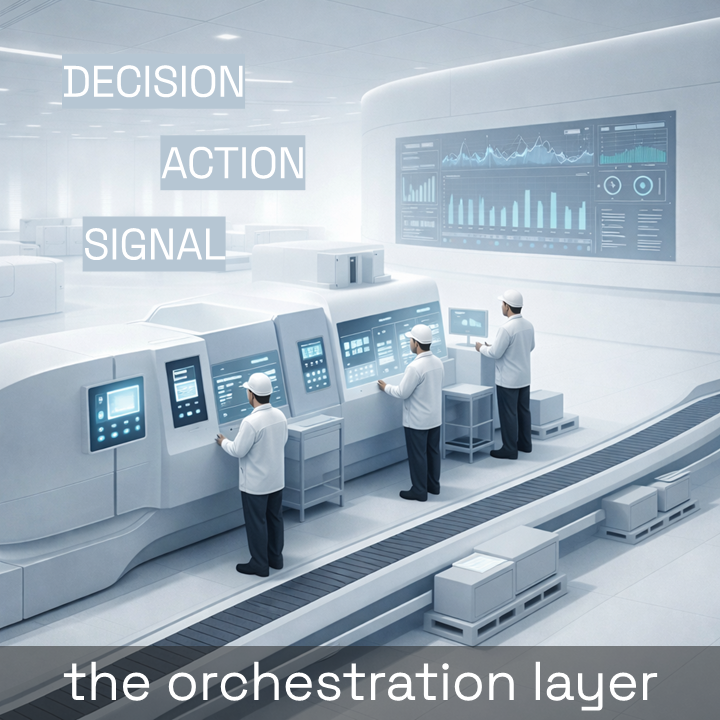
Control no longer comes from visibility alone. It comes from the layer that defines decisions, compresses signals, and triggers action in time.
Signal
Across intelligent operating environments, a consistent pattern is appearing.
Infrastructure moves. Systems generate data. AI produces insight. But action still stalls. The problem is rarely a total absence of information. It is that the path from signal to decision to action remains unclear, overloaded, or unowned. As a result, visibility increases while operating performance does not improve proportionally.
This is why a new control layer becomes necessary. Not another dashboard, not a general AI claim, and not a larger data estate. What becomes essential is a governed decision path that can define what matters, who owns it, and what happens when thresholds are met.
Why it matters
The real failure point is often the decision layer.
Organizations can invest heavily in sensing, automation, analytics, and models yet still fail to create durable advantage if three conditions are missing: a clear owner for the decision, a trusted signal set, and an enforced action path. Without these, intelligence accumulates as activity rather than becoming operational leverage.
That is why orchestration matters. It is the layer that turns system activity into governed action. It determines which loops should run automatically, which require escalation, which are reversible, and which need explicit human oversight. In practical terms, orchestration is where control moves from visibility to governed action.
Operational consequence
Leaders should treat orchestration as a design problem, not a tooling add-on.
The core tasks are straightforward, even if the execution is not. Define the decision. Assign one owner. Compress the signal set to what genuinely changes the decision. Establish thresholds for action, escalation, or stop conditions. Build reversibility where the exposure justifies it. These are operating disciplines, not just technical features.
This matters because the organizations that control the decision path respond faster, waste less managerial attention, and improve throughput without relying on constant manual intervention. The organizations that do not build this layer remain dependent on fragmented tools, delayed action, and external systems whose logic they do not control.
Decision implication
Choose one loop that matters and design the orchestration layer around it.
Do not start with broad AI transformation language. Start with a bounded workflow where the commercial consequences are visible and the lag is measurable. Name the owner. Define the proof threshold. Determine which signals are trusted enough to trigger action. Clarify when the system should act automatically, when it should escalate, and when it should stop.
The design is useful only if it produces a decision path with one owner, trusted signals, explicit thresholds, and measurable improvement in timing or control.
That exercise reveals whether the organization is actually building control or simply adding more intelligence to an already overloaded environment. As systems become more real-time, the central strategic question is not who has the most data. It is who owns the layer that decides and acts in time.
Read the recap of the Programming Reality series.
Perspectives: Stay tuned, coming April 14th
