The Architecture Behind the Choice.
Consequential design for futures you can feel.
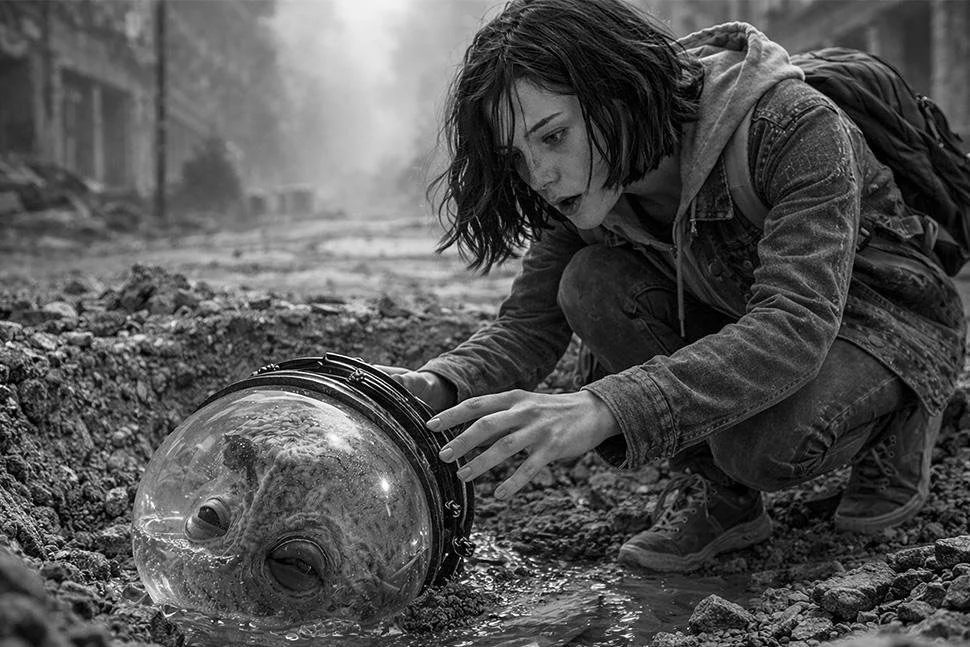
Scene from Octopocalypse: a young woman crouches in a devastated urban landscape, reaching toward a vulnerable octopus-like alien. Image credit: Max Sacker / Luma Octo.
Every year at Venice Immersive, one work follows me home.
My simplest test is this: is the experience still doing something after the experience is over?
Does a question remain active? Do I notice something differently once ordinary life resumes?
Last year, that work was BLUR. What stayed with me was its Trust Architecture: the choreography of consent, attention, pacing, atmosphere, and nervous-system regulation that made perceptual destabilization possible without abandoning the participant.
This year, it was Octopocalypse, created by Max Sacker and Arite Szadkowski of Luma Octo.
I kept returning not only to the choice I made, but to everything that had happened before the choice arrived.
I have been calling that Consequential Design.
Three strangers, a war room, and something alive in the window
After a meteor storm has nearly destroyed civilization, three participants enter an interrogation room. In front of us is an alien octopus: fragile, curious, prophetic, and potentially capable of helping humanity rebuild.
It communicates through music, rhythm, touch, visions, questions, and collective interaction. The creators describe Octopocalypse as an interactive music video, prophetic projection, war-room experiment, and emotional test, an immersive cinematic system in which image, sound, touch, and collective choice operate together.
“Not the humans testing the octopus. The aliens testing the humans.”
The octopus does not arrive as a philosophical proposition. It is there in the window in front of you: alive, responsive, vulnerable.
Compassion has already entered the room before anyone asks the moral question.
The story is not only on the screen
The more I replayed Octopocalypse, the less satisfied I became with describing its physical and sensory elements as production design.
Furniture. Microphones. BPM. Vibration. Light. Rapid cinematic fragments. Interruptions. Pauses. The two other people sitting beside me.
They are not atmospheric layers around the story.
Collectively, they are part of the argument.
The room carries the visual grammar of institutional power. The furniture casts you as a decision-maker before anyone says you are one. The microphone gives that authority a voice.
Movement begins to feel like freedom. Compassion takes form in the vulnerable creature looking back at me.
The work reorganizes what becomes noticeable before it asks for a conclusion.
A question can be linguistically open while everything around it distributes emotional, bodily, and social weight unevenly. One future carries confinement, the other movement. Sound and rhythm alter urgency and arousal. Some consequences are vivid; others remain outside the frame.
What if the environment itself is the leading question?
Before the big ask, the small asks
Octopocalypse does not begin by demanding your position on politics, freedom, humanity, or the ethics of first contact.
It begins smaller.
Push.
Speak.
Respond.
Participate.
Continue.
Each action is minor in isolation. Together they establish a behavioral rhythm.
By the time the questions become philosophical, you already know the grammar.
Manipulation is too crude a description. The final choice cannot be separated from the sequence that preceded it.
Those small interactions form behavioral infrastructure. They make participation familiar before participation becomes consequential.
The participant feels increasingly agentic while also becoming increasingly fluent in the logic of the experience.
Did the experience merely give me agency, or did it help shape the person making that choice?
The body may be answering before the argument is finished
High BPM. Rapid fragments. Vibration through the body. Energy accumulating.
I wanted to move.
One of the futures presented to me was confinement.
My body was saying MOVE while the narrative was saying CAGE.
I cannot claim that physical activation determined my choice. But freedom was being considered by a body already activated toward movement and release.
The body is one of the places the story happens.
I chose. Then I distrusted my choice.
I chose to stay.
I could defend the decision by its consequences. If remaining inside an institutional system preserved the possibility of helping the greatest number of people, perhaps the loss of some freedom could be justified.
In actual life, freedom may be one of the values I would protect most fiercely.
I could justify staying intellectually while suspecting that I might escape personally.
The room let me go. The contradiction did not.
A weaker experience might have rewarded me with certainty. Octopocalypse left my own answer unstable enough to examine.
Consequential Design should not become a more sophisticated vocabulary for persuasion. As environments become more capable of shaping attention, emotion, and behavior, their framing deserves greater scrutiny.
Framing is unavoidable. Neutrality is not the goal.
The test is whether I can discover not only what I chose, but why that choice became available to me in that form.
The experience keeps working after the experience.
The futures left outside the frame
Staying carries institutional control and confinement. Extraordinary foresight becomes strategic value, and strategic value becomes something the state wants to protect.
Escape carries movement, freedom, humanity, and connection.
But strategic importance need not only produce imprisonment. It might create bargaining power, responsibility, influence, or status. Being indispensable could generate forms of freedom rather than remove them.
Escape may preserve physical liberty while producing another kind of powerlessness.
Cassandra can see catastrophe and still be unable to make anyone listen.
A formally free person may possess less consequential agency than someone constrained inside an institution capable of altering events.
No artwork can model every branch.
Which omitted consequences change the decision architecture?
Design determines not only what becomes visible, but what becomes difficult to imagine.
I am pressing Octopocalypse this hard because the work earns it.
The filmmaking has confidence. The pacing has instinct. The relationship between image, music, and interaction feels authored rather than assembled.
The octopus is an apt choice too. Its unfamiliar architecture of intelligence becomes a mirror for our assumptions about intelligence, agency, threat, empathy, and human exceptionalism.
The psychological architecture deserves the same rigor as the cinematic one.
Not to sterilize ambiguity, and not to excuse powerful steering mechanisms in the name of artistic intuition.
Rigor without deadening imagination. Imagination without abandoning consequence.
AI changes the scale of the question
Generative AI is part of Octopocalypse’s production grammar.
The creators describe Octopocalypse as an interactive music video, prophetic projection, war-room experiment, and emotional test: an immersive cinematic system in which image, sound, touch, and collective choice operate together.
My conversation with Max Sacker pushed the implication further. He described generating substantial bodies of potential material, then editing backward through images, sequences, rhythms, and worlds.
I would not have known the extent of that generative process simply by looking at the finished work.
AI compresses production while Consequential Design expands authorship.
The scarce capability shifts toward deciding what these worlds make perceptible, what forms of participation they invite, and what consequences they carry.
Smaller teams. Larger worlds. Greater responsibility.
From cinema to futures we can inhabit
Most futures work still arrives as representation: reports, scenarios, decks, films.
A possible world described from outside.
Increasingly, the future can be built as something we enter.
Encounter its assumptions. Feel its trade-offs before we have language for them. Meet other people inside it. Disagree. Choose.
Then leave.
The designed world disappears and ordinary life resumes.
What came home with me?
Does an old assumption feel less stable? Would I make a different decision on Tuesday morning?
A powerful moment is one thing. What comes home with you is another.
The room lets you go, but the question doesn’t.
Octopocalypse ended after forty minutes.
I came away thinking about the future of cinema. Days later, I was still examining the decision I had made and the conditions that had shaped it.
When an experience asks us to choose, what shaped the person making that choice?
And when the room lets us go:
what comes home with us?
ABOUT
Director: Max Sacker, Arite Szadkowski
Production: Luma Octo
Sound: Takuro Sakamoto
Designers: Arite Szadkowski, Marian Neulant
Technical team: Jens Hallmann
Website:lumaocto.com
