
Agents enter the team workflow
Why shared AI agents need input governance before they become part of the workflow
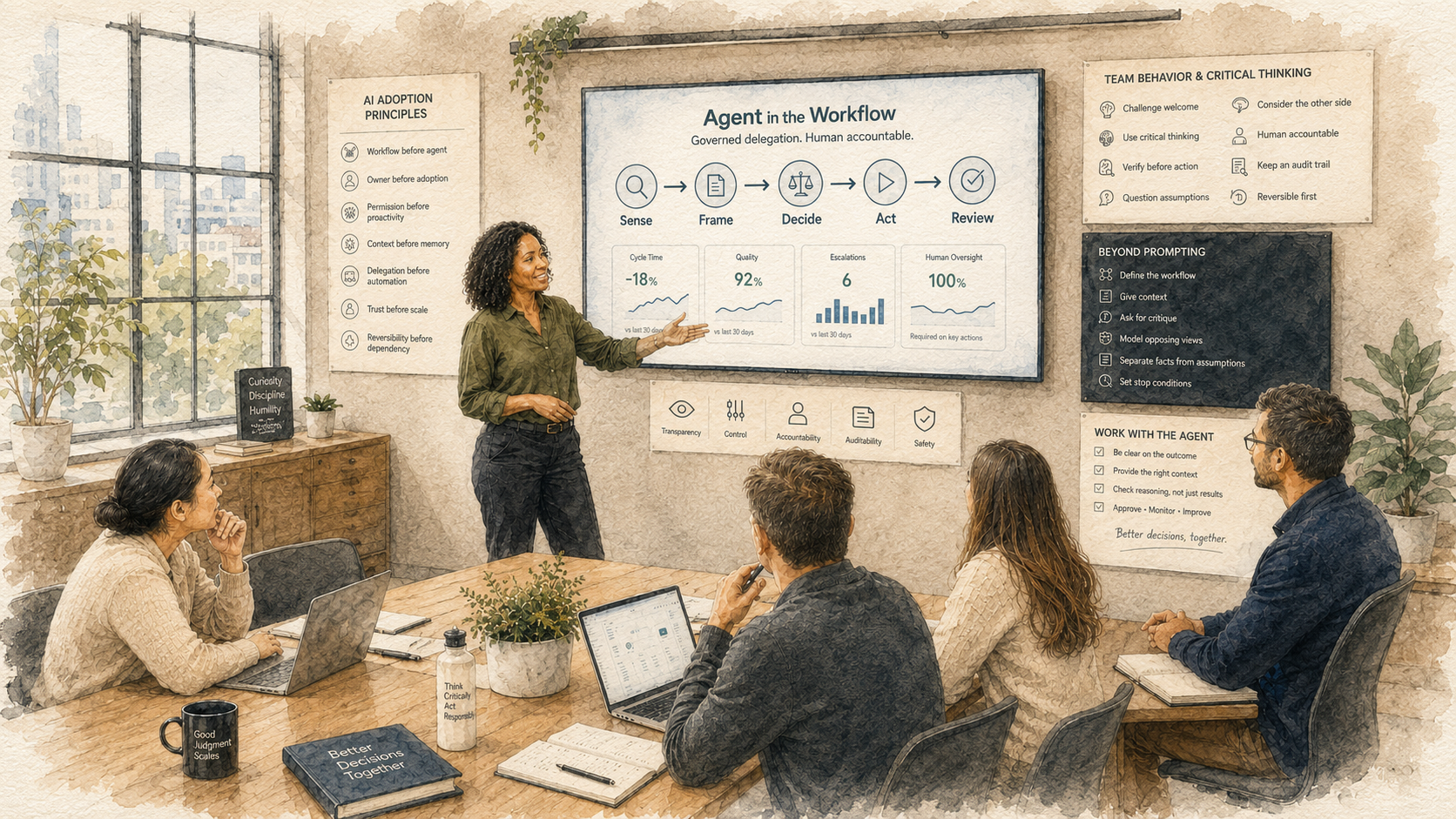
Govern the team input layer before treating an AI agent as part of the operating workflow.
Signal
A familiar shift is now visible inside enterprise work.
AI is moving out of the private prompt box and into the channels where work is coordinated.
Claude Tag is one visible signal. Microsoft Copilot and Gemini Enterprise point in the same direction. The agent is no longer only a sidecar for an individual employee. It is beginning to sit inside Slack, Teams, Google Chat, Outlook, SharePoint, shared project spaces, and the operational threads where decisions are shaped.
At first, this looks like a productivity improvement.
A team can tag the agent. It can summarize a thread, draft the next update, retrieve a document, compare versions, check a dashboard, or move a task forward. The value is easy to see because the interface sits where people already work. There is less need to copy context into a separate tool. The agent can access the permitted working context and respond inside the same channel.
That is exactly why the shift matters.
Once AI enters the shared channel, it is no longer helping only one person move faster. It starts to influence what the team sees, what gets named, what becomes the working draft, what is remembered, what is escalated, and what quietly becomes the next step.
The channel becomes a control surface.
This changes the adoption question. The question is no longer only which model to use, which tool to license, or how many employees are active. The more important question is whether the organization has a protocol for how agents enter shared work.
Who is allowed to invoke the agent?
Which channels can it read?
What context can it retain?
What can it act on?
What requires human approval?
Who can challenge the output?
Who owns the decision when the output is used?
These questions are not technical afterthoughts. They are operating questions.
Why it matters
Most organizations are still treating AI adoption as an individual capability curve.
They train users. They circulate prompt guidance. They track licenses, usage, enthusiasm, and early wins. A few power users move quickly. Some teams see immediate productivity gains. The organization begins to feel that AI diffusion is underway.
Then the agent enters the shared workflow.
At that point, the issue changes.
The behavior of the team becomes part of the system.
People notice who tags the agent first. They notice which version becomes the working version. They notice whose language turns into the status update. They notice which concern is elevated and which concern is summarized away. A fast AI-generated response can feel like progress before the team has actually aligned.
This is not crude office politics. It is ordinary organizational behavior.
Every team already carries subtle gravity: status, confidence, timing, ownership, hesitation, trust, fluency, and habit. An agent can amplify that gravity. The most confident user may shape the first prompt. The first draft may become the anchor. The most fluent person may gain more leverage because the system turns their framing into structured output faster than others can respond.
In a sales channel, an agent may turn one person’s framing into the pursuit strategy.
In a product channel, the first AI-generated specification may become the default architecture.
In an incident channel, the room may narrow around a fast diagnosis before the right people have challenged the assumptions.
In a leadership channel, a polished summary may make unresolved disagreement look like alignment.
Ramp offers a useful comparison. The lesson is not that every company should build its own Glass. It is that high AI usage did not automatically become institutional capability. The bottleneck was the harness: connected context, shared skills, memory, reusable workflows, and a way for one person’s better way of working to become available to others. The same principle applies when agents enter team channels. Local fluency is not enough. The work has to become governed, reusable, and owned.
The problem is not that AI is present. The problem is that the input layer is unmanaged.
Input governance means deciding what the agent can see, take in, remember, act on, and escalate. It also means deciding how the team can question, correct, slow down, or override what the agent produces.
That last part is critical.
If people cannot challenge the output without sounding anti-AI, the organization has not created intelligence. It has created pressure. The agent becomes a symbol of momentum rather than a support for better judgment.
This is where adoption can go wrong even when the tool works.
The model may be strong. The integration may be useful. The user experience may be smooth. But the team may still lack the behavioral protocol required to use the agent safely inside a shared decision environment.
Operational consequence
Leaders should treat team-channel agents as part of the operating model, not as another productivity plug-in.
The practical move is to create an admission protocol before placing agents inside shared workstreams. The protocol does not need to be heavy. It does need to be explicit.
Start with one workflow.
A team should not add an agent to a general channel simply because the technology is available. It should choose one recurring workflow where the value is observable and the risk is understandable.
Examples might include:
A sales pursuit channel where the agent helps synthesize customer context, draft follow-ups, and track next actions.
A product delivery channel where the agent compares requirements, flags unresolved decisions, and prepares review notes.
An incident response channel where the agent summarizes live updates, extracts hypotheses, and tracks unresolved risks.
A compliance channel where the agent organizes evidence, highlights missing documentation, and prepares review packs.
A customer support escalation channel where the agent summarizes case history, proposes resolution paths, and identifies when escalation is required.
The workflow should be narrow enough to govern and important enough that improvement matters.
Then define the agent’s role.
Is it a summarizer, researcher, critic, coordinator, drafter, monitor, or escalation assistant? Those roles are different. Each requires different permissions, review rules, and evidence standards.
A summarizer may need access to threads and documents but no authority to trigger action.
A monitor may need access to workflow signals and thresholds but a clear escalation boundary.
A drafter may support communication but require named human approval before anything is sent.
A critic may be deliberately asked to challenge assumptions, identify missing evidence, and model opposing views.
A coordinator may track tasks and dependencies, but should not quietly change ownership or deadlines without review.
The next step is to define the input boundary.
Which channels can the agent read?
Which files can it access?
What sensitive data is excluded?
What memory is allowed?
What must be forgotten?
What should be logged?
What outputs, prompts, or workflows can be reused across the team?
Without this boundary, context becomes exposure. The agent becomes more useful because it sees more, but the organization may not know what it has allowed into the operating surface.
Then define the output boundary.
What can the agent suggest?
What can it draft?
What can it change?
What can it escalate?
What can it never do?
Which outputs are advisory only?
Which outputs require human review?
Who approves final use?
This is where bounded delegation becomes practical. The organization is not asking whether AI can help. It is defining the conditions under which AI may participate in the work.
The proof threshold should be established before the agent becomes normal.
A useful team-channel agent should improve the loop without creating hidden dependency or extra review burden. Proof might include faster cycle time, lower rework, better decision traceability, fewer missed follow-ups, improved handoff quality, clearer escalation behavior, or reduced preparation time.
But the proof should also look for negative effects.
Does the agent increase noise?
Does it create more review work?
Does it make premature alignment more likely?
Does it privilege the fastest or most fluent user?
Does it produce summaries that flatten dissent?
Does it make ownership less clear?
Does it create dependency on a vendor, memory layer, or channel configuration that the team cannot inspect?
If those risks are visible, the answer is not necessarily to remove the agent. The answer is to redesign the loop.
That may mean reducing permissions, tightening the workflow, changing the review rule, creating a challenge step, adding a named owner, limiting memory, or shifting the agent from proactive mode to request-only mode until the team is ready.
This also changes the purpose of AI training.
Training should not only teach people how to prompt. It should teach people how to work with an agent inside a shared operating loop.
That means role-specific fluency:
When to use the agent.
When to verify.
When to challenge.
When to escalate.
When to reject an output.
How to document what happened.
How to preserve human accountability.
How to prevent speed from substituting for alignment.
The most mature teams will not be the ones that use agents everywhere. They will be the ones that know where an agent belongs, what role it plays, and what boundary keeps the work legible.
Decision implication
Before adding an agent to a shared channel, choose one workflow and design the operating protocol around it.
Do not start with the agent.
Start with the decision, handoff, or recurring work loop that needs to improve. Name the business owner. Define the workflow. Identify what context the agent needs and what context it should not access. Decide whether the agent is summarizing, drafting, monitoring, critiquing, coordinating, or escalating. Set the evidence standard. Set the review rule. Set the memory boundary. Set the stop condition.
Then test whether the agent improves the workflow under real team conditions.
The decision is simple.
If the agent cannot be governed as part of a decision loop, it should not be treated as part of the workflow.
This is the shift from AI adoption to operating design.
The advantage will not come from having more agents in more channels. That may only create more noise, more dependency, and more ambiguous accountability. The advantage will come from having one governed workflow where the agent improves timing, clarity, review quality, and decision confidence without displacing human responsibility.
For executives, operators, and transformation leads, the near-term task is practical.
Choose one team channel where work already carries consequence. Define the workflow. Name the owner. Bound the agent. Make challenge acceptable. Require evidence where it matters. Preserve an audit trail. Keep the loop reversible until proof exists.
Govern the input layer, or the agent will govern it for you.
Choose one shared workflow, name the owner, define the agent’s role, and set permissions, memory, review, escalation, and stop conditions before expanding agent use across team channels.
Read next: Operations is becoming the intelligence layer
How Loop Exit’s approach fosters decision integrity inside the workflow, not capability beside it.
