
AI pilots need governance loops
Why regulated enterprises should turn AI pilots into governed workflow loops before scaling AI adoption.
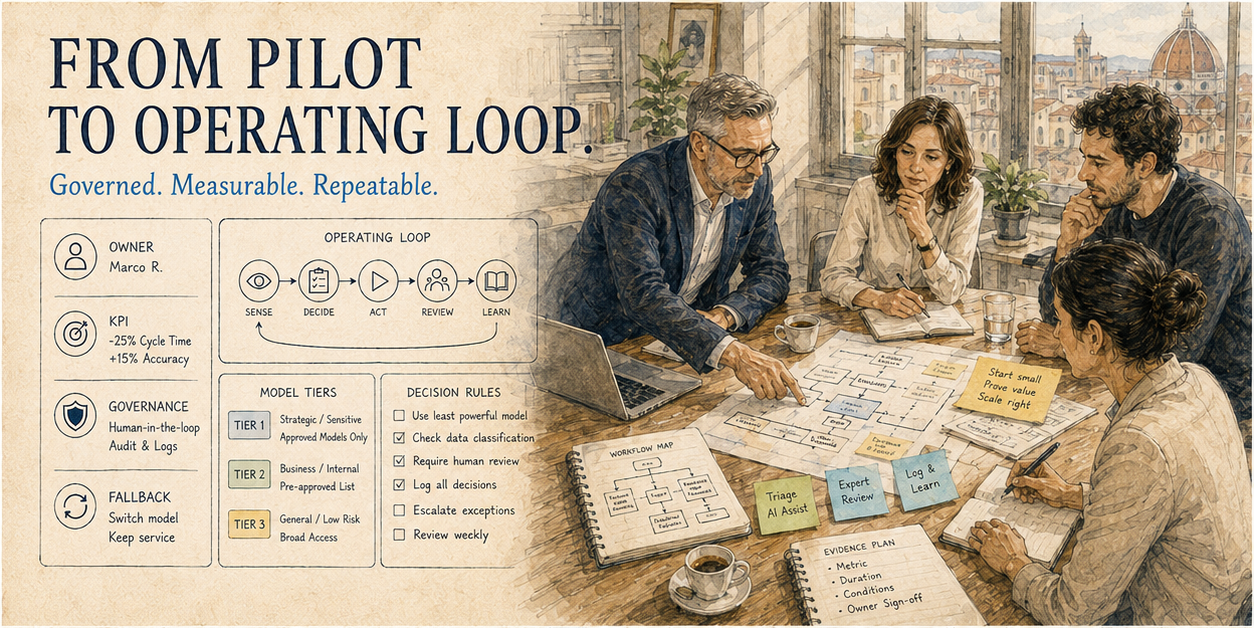
Do not scale AI activity; scale only the governed workflow that has earned proof.
Signal
A familiar pattern is emerging inside regulated enterprises.
The organization buys licenses. Copilot seats are assigned. Acceptable-use policies are circulated. Teams run pilots. A few outputs look promising. There is visible movement and a sense that the company is finally “doing AI.”
Then the operational questions arrive.
Who owns this workflow?
What data was used?
Which model produced the output?
Was human review required?
Where is the evidence trail?
What happens if the model changes, the vendor changes policy, or the process is audited?
This is where many AI programs slow down. The issue is not that pilots are useless. Pilots are useful. They let teams test capability without committing the whole organization.
The problem is the pilot that impresses in a meeting, then disappears before it changes how work gets done.
That distinction matters in insurance, fintech, banking, legal, life sciences, healthcare, and other regulated environments. A claims workflow, KYC review, fraud investigation, underwriting support task, complaint-handling process, or regulatory documentation workflow does not become ready for controlled use because the first output looked good.
It becomes ready when the workflow can be owned, reviewed, measured, and governed under real operating conditions.
That is the signal.
Enterprise AI adoption is moving from tool access and isolated pilots toward governed workflow loops.
Why it matters
Most AI adoption programs still over-measure the visible surface of adoption.
They track seats, usage, training attendance, pilot count, prompt libraries, and enthusiasm.
Those indicators are not meaningless, but they do not prove that the operating model has changed.
They show that AI activity is happening. They do not show whether a workflow has become faster, safer, more reliable, or easier to control.
Regulated enterprises need a higher standard.
The first standard is workflow legibility.
AI does not need every step to be visible to humans. Agentic systems can operate across data flows, logs, events, and machine-readable process states that no manager personally watches. That is part of the value.
But the workflow still needs to be readable by the system and governable by the organization.
Inputs must be known.
Rules must be explicit.
Exceptions must be defined.
Approvals must be visible.
Logs must be captured.
Escalation paths must be clear.
Owners must be named.
Without that, agentic automation becomes fast ambiguity.
The second standard is governance inside the workflow.
Many companies still treat governance as a separate layer: a policy, a committee, a risk checklist, or a compliance review at the end of the pilot.
That creates drag because governance arrives too late. The workflow has already been imagined, tested, or socialized before the hard questions appear.
In regulated environments, governance has to be designed into the loop from the beginning.
What data can the system use?
Which model or model tier is approved?
When is human review mandatory?
What must be logged?
Which outputs are advisory only?
When does the workflow escalate?
What proof is required before scale?
The third standard is evidence before expansion.
A promising demo is not proof. A useful pilot is not yet a scalable workflow.
A pilot earns the right to expand only when it performs under realistic workload, real data boundaries, real review burden, and real governance constraints.
This is also where the European context matters.
The EU AI Act is pushing organizations toward stronger AI literacy, role-specific awareness, oversight, and documentation. In Europe, governance is not the opposite of AI adoption.
It is one of the conditions that makes adoption possible at scale.
For insurers, banks, fintechs, and other regulated enterprises, the relevant question is not whether AI should be used. It is whether the workflow can be made specific enough, owned enough, and evidenced enough to be trusted.
Operational consequence
The practical move is to redesign the pilot container.
A useful enterprise AI pilot should not be framed as a general experiment. It should be framed as the first version of a governance loop.
Start with one recurring workflow that already matters.
In insurance, that might be claims triage, policy comparison, fraud case summarization, broker support, or underwriting preparation.
In fintech, it might be KYC review support, AML case preparation, complaint analysis, risk memo drafting, customer support escalation, or compliance evidence extraction.
In life sciences or healthcare, it might be regulatory writing support, clinical documentation assistance, or controlled knowledge retrieval.
The workflow should be narrow enough to observe in detail and important enough that improvement matters commercially.
Then extract the operating logic before automating it.
Sit with the people who actually do the work.
Capture the steps, handoffs, exceptions, judgment points, approval rules, risk categories, source documents, decision criteria, and quality markers.
The goal is to define what the workflow needs in order to become machine-readable and managerially controllable.
Once that work is visible, design the governance loop around it.
The loop should specify:
Workflow owner
Risk owner
Data boundary
Approved model or model tier
Human review rule
Logging requirement
Escalation path
Fallback option
Proof threshold
It should also define the review cadence: when the pilot is assessed, who certifies progress, and what evidence is required to continue, stop, or scale.
The proof threshold should be explicit before the pilot begins.
For example, a claims triage loop might need to reduce cycle time without increasing escalation errors. A KYC review support loop might need to reduce manual preparation time while maintaining complete evidence trails.
A complaint analysis loop might need to improve classification consistency without increasing review burden.
A regulatory writing loop might need to improve draft speed while preserving traceability to approved sources.
Useful proof might include:
Reduced cycle time
Lower rework
Fewer compliance defects
Complete audit logs
Stable or reduced reviewer burden
Higher reviewer acceptance
No unauthorized data exposure
Tested fallback paths
Clear escalation behavior
The idea should be invalidated if:
No owner is accountable
The data boundary is unclear
Outputs cannot be reviewed
Logs are incomplete
Human review burden expands
The risk team cannot approve the control model
The workflow shows no measurable improvement under normal operating conditions
This changes the role of AI training.
Training should not only explain how to use a tool. It should teach people how to operate inside the loop.
A legal team, claims team, risk team, sales team, or compliance team needs role-specific fluency around the workflow it is responsible for:
when to use AI
when to verify
when to escalate
when to reject an output
how to document what happened
It also changes the role of governance.
Governance is no longer a brake applied after experimentation. It becomes part of the operating surface. It gives the organization permission to move because it makes the movement reviewable.
A governed workflow can be improved, audited, transferred, measured, and scaled. An ungoverned pilot remains activity without operational consequence.
For regulated enterprises, this is the difference between AI experimentation and AI enablement.
Decision implication
Before expanding AI further, choose one pilot and convert it into a governance loop.
The right candidate will usually have visible friction: recurring manual judgment, repeated document handling, slow handoffs, inconsistent quality, unclear escalation, or high review burden. It should also have a business owner who cares about the outcome and a risk owner who cares about the boundary.
Do not start with the model. Start with the workflow.
Define the work clearly. Name the owner. Identify the data that can be used. Classify the risk. Decide which model tier is appropriate. Set the review rule. Capture the evidence trail. Define the fallback path. Make the proof threshold explicit.
If the workflow cannot be owned, reviewed, logged, and reversed, it should not be scaled.
If it can, the pilot becomes something more useful than an experiment. It becomes the first operating loop through which the organization learns how to use AI responsibly under real conditions.
That is where enterprise adoption becomes repeatable.
The advantage is not having more AI in the organization. It is having one governed workflow that improves work, protects trust, and gives leadership the confidence to scale what has actually been proven.
Do not scale AI activity; scale only the governed workflow that has earned proof.
Choose one regulated workflow, extract its operating logic, assign ownership, define the governance boundary, and set the proof threshold before expanding AI.
Read next: Proof Before Scale
How Loop Exit runs bounded pilots before broader commitments harden.
