
The AI bill has reached the CFO
Why leaders need allocative AI, model routing, CISO-grade exposure rules, and workflow-level proof before scale.
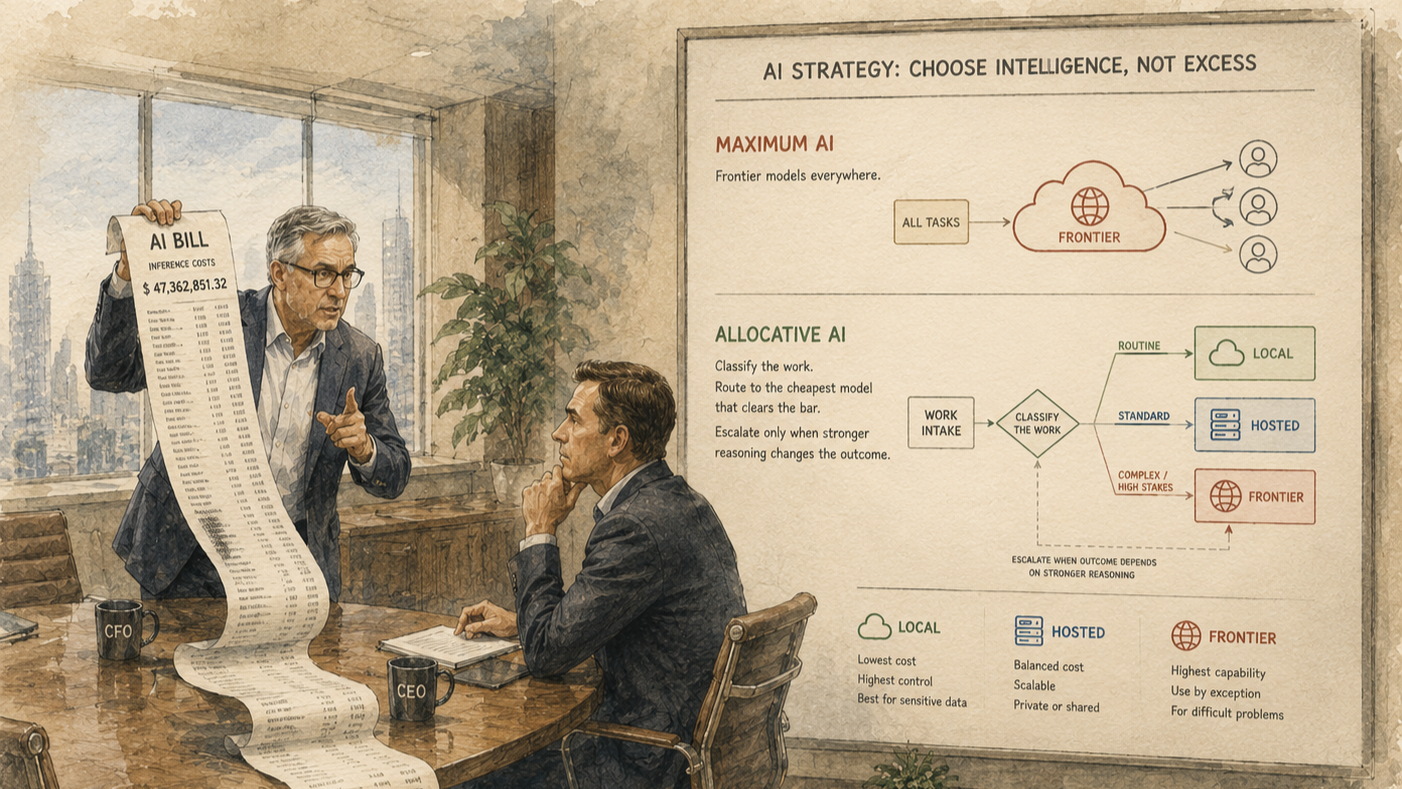
Allocate intelligence according to workflow value, risk, exposure, and proof.
Signal
No one sends a cardiac surgeon to take blood pressure.
The reading may be correct. The expertise may be world-class. The cost is still absurd.
That is the condition now appearing inside enterprise AI adoption. In the first phase, the priority was access. Leaders wanted teams to experiment, test tools, build familiarity, and discover what AI could do. That was the right impulse. Organizations needed a period of open exploration before they could understand where the technology might matter.
But experimentation is becoming operating cost.
The AI bill has reached the CFO.
Inference is no longer an invisible technical detail buried behind a subscription. It is becoming a recurring cost line attached to workflows, teams, tools, and vendors. As agentic systems move closer to daily work, usage can expand quickly. A simple request becomes a chain of actions. A draft becomes iteration. A workflow becomes repeated execution, review, correction, and escalation.
That changes the management question.
The old instinct was to use the strongest available model. It felt safer, simpler, and easier to justify. But as AI becomes more embedded in operations, that instinct starts to create waste. Many routine tasks do not require frontier reasoning. Some sensitive tasks require lower exposure more than higher intelligence. Some workflows need latency, control, auditability, or sovereignty before they need the most powerful model available.
The signal is that AI usage now needs routing rules, named owners, exposure boundaries, and cost-per-workflow review.
Why it matters
The strategic choice is not between enthusiasm and restraint.
It is between maximum AI, unruly experimentation, and allocative AI.
Maximum AI puts the strongest model everywhere. Every task receives premium intelligence whether or not the work deserves it. This can look advanced from the outside while quietly turning routine work into expensive inference.
Unruly experimentation has the opposite problem. Usage spreads without clear ownership, routing rules, spend thresholds, data-boundary controls, or evidence of workflow value. It creates activity, but not necessarily control. It may generate useful discoveries, but it also makes it difficult for leadership to understand where AI is improving performance and where it is simply increasing consumption or exposure.
Allocative AI is the disciplined alternative.
It classifies the work, assigns an appropriate model tier, and escalates only when stronger reasoning changes the outcome.
This is how AI begins to resemble labor mix.
Senior expertise is not used for every routine task. Premium talent is reserved for work where stakes, ambiguity, judgment, or consequence justify the cost. Standard work receives standard capability. Sensitive work is handled through the safest viable path. The same operating logic now applies to AI.
Local where possible.
Private where needed.
Frontier by exception.
The performance gap between smaller, local, and specialized models is narrowing for many routine tasks, while the cost and exposure gap can remain wide. The executive issue is not model quality in the abstract. It is whether the organization can match the level of intelligence to the workflow that actually needs it.
This is where the CISO office becomes central.
Allocative AI is not only cost allocation. It is exposure allocation.
A model-routing decision is also a data-routing decision. It determines where information travels, which vendor environment sees it, what can be retained, which logs exist, what controls apply, and what risk the organization accepts. Without CISO involvement, AI routing can become shadow architecture: technically useful, commercially attractive, and quietly misaligned with security, privacy, and compliance requirements.
That creates two risks at once.
The first is overspend: frontier models doing routine work.
The second is unmanaged exposure: sensitive workflows crossing boundaries without explicit approval.
A third risk follows from overcorrection. If cost and security controls become too blunt, teams may retreat into safe productivity use cases and never discover where AI can change cycle time, review burden, error rates, decision quality, or revenue throughput.
Caps can protect the budget. Controls can protect the enterprise. But if they are not designed around workflows, they can also narrow imagination.
The larger opportunity is to redesign high-friction workflows around governed intelligence.
Operational consequence
Leaders should treat AI usage as an operating design problem, not a tool-access problem.
The practical question is no longer, “Which model should we buy?” The better question is, “What level of intelligence does this workflow require, under which conditions, at what cost, and with what exposure?”
That question needs shared executive ownership.
The CFO should own spend discipline.
The CIO should own technical architecture and integration.
The CISO should own exposure boundaries, data-handling rules, and exception governance.
The business owner should own the workflow outcome.
Without that ownership model, AI adoption defaults to invisible decisions. Teams use what is available. Vendors shape consumption. Sensitive information crosses boundaries through convenience rather than policy. Leadership sees the bill, the risk, or the failure only after behavior has already formed.
The operating metric should also change.
Token consumption is not enough. Seat adoption is not enough. Prompt volume is not enough.
The useful metric is inference cost per completed workflow, reviewed against exposure and outcome.
That metric forces a better conversation. It connects AI spend to work accomplished. It shows where premium reasoning is justified and where cheaper or more private systems are sufficient. It makes waste visible without reducing AI governance to blunt restriction.
A routine internal summary may default to a lower-cost model.
A confidential document workflow may default to private inference.
A regulated legal, industrial, or financial judgment may require a stronger model, human review, audit trail, and clear escalation logic.
A strategic decision-support workflow may justify frontier reasoning if it changes the quality of the decision, reduces risk, or compresses time in a way that matters commercially.
A workflow should keep its assigned tier only if it improves cycle time, quality, review burden, decision confidence, or risk control enough to justify its cost and exposure.
If it increases cost without improving the completed workflow, the tier should be lowered.
If it increases exposure without a justified business return, the routing rule should change.
If it requires repeated human correction, the workflow is not ready to scale.
The point is to allocate intelligence.
Decision implication
Before expanding AI spend further, executives should classify the work.
A useful first move is to identify the top ten AI workflows already emerging inside the organization. These may include research, reporting, software development, customer support, proposal writing, legal review, industrial troubleshooting, knowledge retrieval, management reporting, or decision preparation.
For each workflow, leadership should define the default model tier, the escalation condition, the data-exposure path, the accountable owner, and the cost threshold.
This should be sponsored jointly by the CFO, CIO, and CISO, with each workflow assigned to a business owner who is accountable for the operating outcome.
The review question should be simple: Did the selected level of intelligence improve the completed workflow enough to justify its cost, exposure, and governance burden?
This is a 30-day management exercise, not a multi-year transformation program. The goal is to move from accidental usage to governed allocation. The company does not need maximum AI everywhere. It needs the ability to decide where stronger intelligence matters, where cheaper intelligence is sufficient, where private inference is required, and where exposure must be limited regardless of model performance.
That is the executive choice now.
Do not stop experimentation. Do not let it remain unruly. Build the allocation layer before AI consumption hardens into unmanaged operating cost and unmanaged exposure.
Do not overspecify intelligence. Allocate it according to workflow value, risk, exposure, and proof.
Within 30 days, have the CFO, CIO, and CISO classify the top ten AI workflows, assign a default model tier to each, define escalation and exposure rules, name the workflow owner, and review inference cost per completed workflow weekly.
Read next: Proof Before Scale
How Loop Exit runs bounded pilots before broader commitments harden.
